How much interest does 10000 earn? Here’s the answer nobody’s bank statement prepares them for: it depends almost entirely on where the money sleeps — and the gap between the right answer and the default answer is now more than ten times.
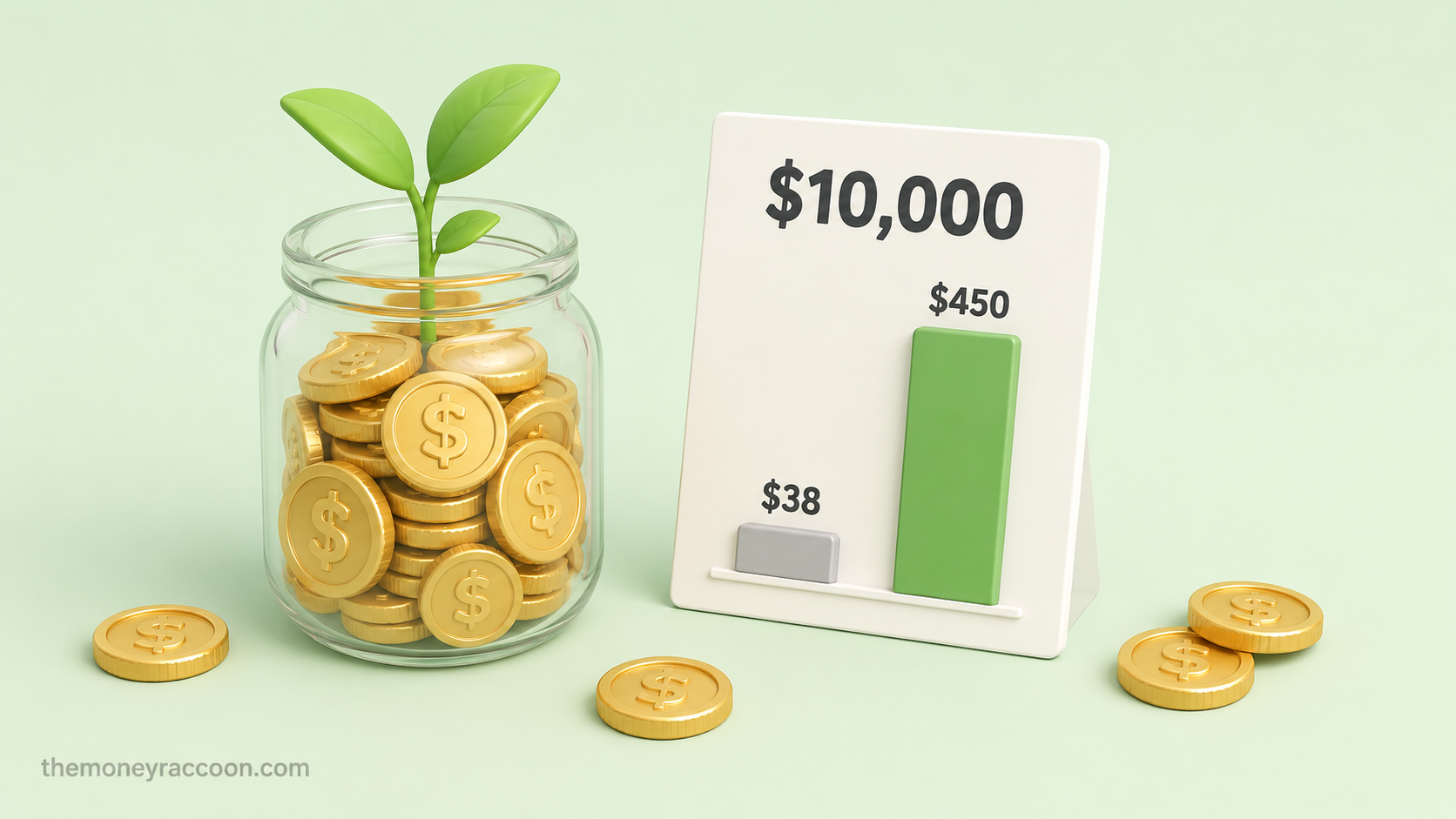
At the national average savings rate (0.38%), your $10,000 earns about $38 a year. Three dollars a month. A coffee.
At today’s top high-yield savings accounts (4.2–4.5% APY), the same $10,000 earns $420–450 a year — money that arrives every month, requires zero risk, zero effort, and zero lock-up. Same deposit insurance. Same access to your cash. The only difference is which account you opened.
Below: the exact math by rate and by time horizon, what happens if you add monthly deposits, the fine print banks hope you skip, and the ten-minute fix.
The two-minute answer: $10,000 earns about $38 a year at the average U.S. savings rate (0.38%) — but $420 to $450 a year in a top high-yield savings account paying 4.2–4.5% APY in 2026. That’s roughly $35–37 every month, and over five years the gap compounds to about $2,270 in extra interest. Both account types are FDIC-insured up to $250,000.
The Math: $10,000 by Rate and by Time
Today’s top HYSA rates run 4.15–4.50% APY, while the national average savings rate sits at 0.38%. Here’s what that difference does to $10,000, with compounding:
| APY | Per Month | 1 Year | 5 Years |
|---|---|---|---|
| 0.38% (national average) | ~$3 | $38 | $191 |
| 4.00% | ~$33 | $400 | $2,167 |
| 4.20% | ~$34 | $420 | $2,284 |
| 4.50% (today’s top) | ~$37 | $450 | $2,462 |
| 5.00% (rare promos) | ~$41 | $500 | $2,763 |
Read the last column twice. Over five years, the average-rate saver earns $191; the high-yield saver earns $2,462. Same $10,000, same zero risk — a $2,270 difference for one afternoon of paperwork, done once.
And if you’re adding to the pile, compounding accelerates: $10,000 + $200/month at 4.5% APY grows to roughly $25,900 in five years — about $2,500 of that is pure interest.
How Much Interest Does 10000 Earn — the Fine Print That Changes the Answer
Four things move the real number:
1. APY vs. interest rate. APY (annual percentage yield) already includes compounding — it’s the honest number and the only one worth comparing. If a bank advertises a “rate” instead of an APY, ask why.
2. Rates float. HYSA rates follow the Federal Reserve, and they’re drifting slightly downward in 2026 — most top accounts trimmed their APY since June. Your rate can change any month, no permission needed. That’s the trade-off for full liquidity (CDs lock a rate; savings accounts don’t).
3. Teaser tiers and hoops. Some headline rates only apply up to a balance cap, or require direct deposit. Read the tier table before moving $10,000 — a “5.00%” that only covers the first $2,000 earns less than a flat 4.3%.
4. Taxes. Interest is taxable income — expect a 1099-INT form at year-end. At $450 of interest, most savers owe $50–100 of it back at tax time. Still an overwhelming win over $38.
The bigger honesty check: if you’re carrying credit card debt at 20%+ APR, that debt is a negative HYSA five times stronger than the positive one. Aim the money there first — paying off a 24% card is a guaranteed 24% return no savings account will ever match.
What $10,000 in a HYSA Is Actually For
A high-yield savings account isn’t an investment — it’s a parking garage that pays rent. It’s the right home for money that must stay safe and reachable:
The emergency fund. Three to six months of expenses, earning $35/month instead of $3 while it waits for a job it hopefully never gets.
Sinking funds. The car repair, the holiday budget, next year’s vacation — the slow-fill envelopes do their waiting here, growing a little while they wait.
Short-term goals. House down payment in 2–3 years? The stock market is too volatile for that clock; a HYSA guarantees the money shows up intact, plus interest.
What it’s not for: retirement money or anything with a 10+ year horizon — at that distance, market investments have historically outrun savings rates by a wide margin. (That’s the Investing conversation, coming soon on this site.)
The 10-Minute Fix
If your $10,000 currently earns 0.38% at a big traditional bank, the upgrade is almost embarrassingly easy: pick a top-rate account from a current comparison list (all FDIC-insured, most with zero fees and zero minimums), open it online in about ten minutes, and link your old account to transfer the balance. Your old bank will not call to warn you about the $412 a year you were leaving behind. They were counting on the silence.
FAQ: How Much Interest Does 10000 Earn
How much interest does 10000 earn per month? At today’s top HYSA rates (4.2–4.5% APY): roughly $34–37 per month. At the 0.38% national average: about $3 per month. The interest typically posts monthly and immediately starts earning its own interest.
How much interest will $10,000 earn in a year in a CD instead? Top 12-month CDs in 2026 pay in the same neighborhood as top HYSAs — roughly $400–450 on $10,000 — but lock the money (and the rate) for the full term. CDs win if rates keep falling; HYSAs win on flexibility. For emergency money, flexibility beats the extra fraction.
Is a high-yield savings account safe? Yes — the accounts worth using are FDIC-insured (or NCUA-insured at credit unions) up to $250,000 per depositor, per bank. A 4.5% APY online account carries exactly the same federal insurance as the 0.38% account at a branch bank.
Why do online banks pay so much more interest? No branches, no tellers, no marble lobbies — online banks run cheaper and compete for deposits with rates instead of real estate. The big traditional banks keep rates near zero because most customers never move their money.
Do I pay taxes on savings account interest? Yes — interest is ordinary taxable income, reported on a 1099-INT your bank sends in January. There’s no way around it (and no, keeping it under $10 of interest isn’t a strategy — it’s just earning less).
Sources and further reading: Bankrate — Best HYSAs of July 2026, Fortune — Top savings rates July 2026, NerdWallet — Best high-yield online savings accounts

Personal finance writer, founder and editor of The Money Raccoon — 5 years in the industry and 1,000+ articles published in the finance niche. I turn complex money rules — credit scores, debt, banking and investing — into plain-English guides backed by primary sources and real numbers. Every guide here is fact-checked against the institutions that publish the data and updated when the numbers change.