
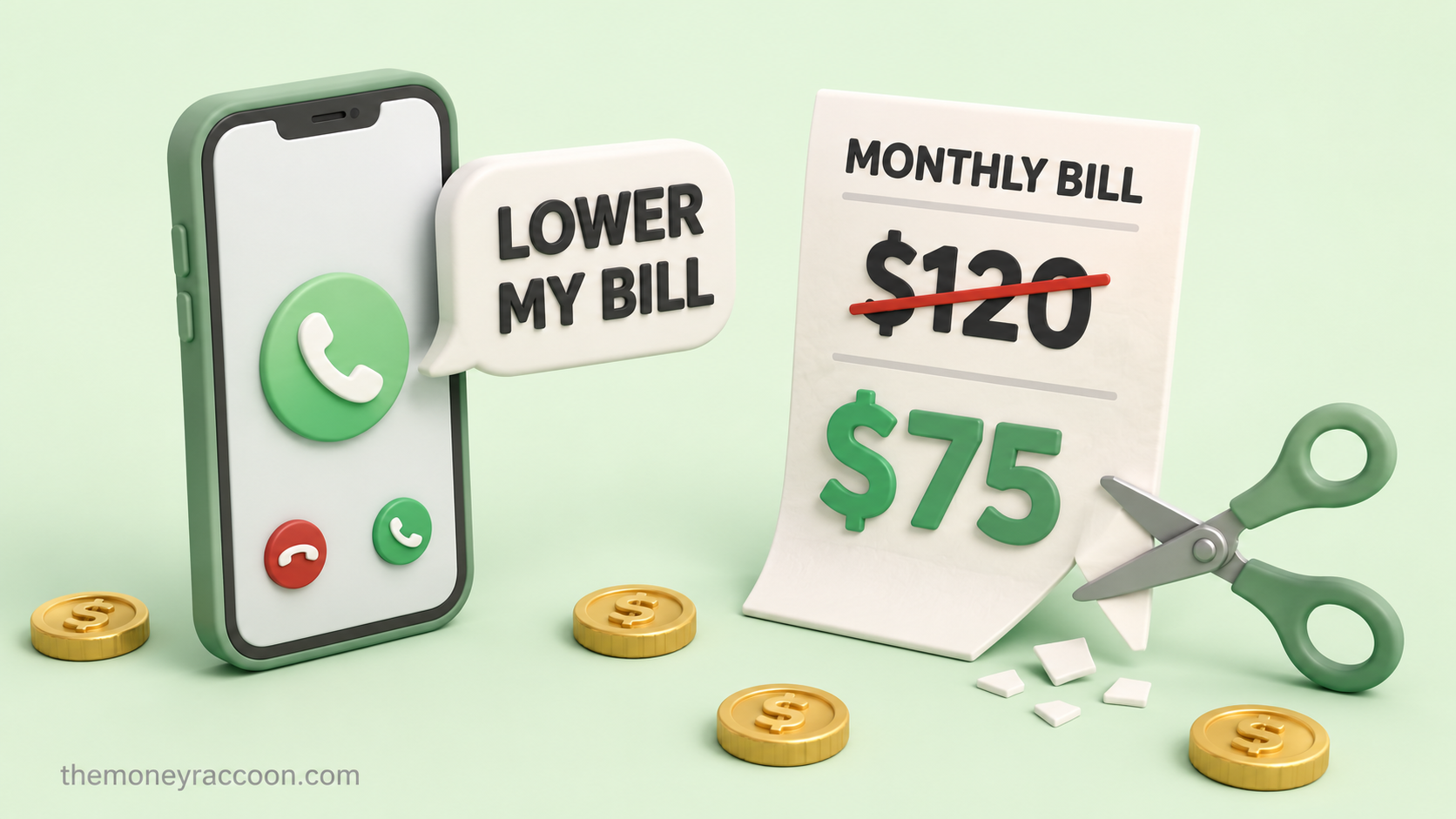
Learning how to negotiate bills is the highest-paid phone call most people will ever make. Twenty minutes, one polite conversation, and the same internet, the same phone plan, the same insurance coverage — for $20, $40, sometimes $80 less per month. Every month. Forever-ish.
And yet almost nobody makes the call. Not because it doesn’t work — the data says it works absurdly often — but because nobody knows what to say. The pause after “I’d like a lower rate” feels terrifying when you’re improvising.
So we’re removing the improvising. Below are seven word-for-word scripts — internet, cell phone, credit card interest, medical bills, car insurance, subscriptions, and rent. Copy, dial, read. That’s the whole method.
The gist: Most monthly bills are negotiable — you just have to ask the right department, with a competitor’s price in hand. In a 2025 LendingTree survey, 83% of cardholders who asked for a lower interest rate got one. Cable, internet, phone, insurance and even medical bills follow the same rule: the first price is an opening offer, not a final one.
Why This Works (It’s Not Luck — It’s Math)
Companies spend a fortune acquiring you. Between advertising, sign-up promos and sales commissions, replacing a customer who walks costs far more than shaving $25 off your bill. Retention departments exist for exactly this reason — employees whose entire job is to keep you from leaving, armed with discounts the regular support line can’t offer.
The numbers back it up. LendingTree found that 83% of people who asked for a lower credit card APR in the past year got one — the highest success rate since the pandemic — with an average cut of 6.5 percentage points. And here’s the detail that should make you optimistic: the most common reason people never ask is that they didn’t know they could.
You now know you can. That’s the entire barrier to entry.
How to Negotiate Bills: The 5-Minute Prep
Before any script, do these four things — they double your odds:
- Pull up a competitor’s offer. One browser tab with a rival’s new-customer price is your leverage. You don’t need to actually want it; you need to be able to read it out loud.
- Know your history. Years as a customer, on-time payments, current monthly price. “I’ve been with you for four years” is a card — play it.
- Ask for the retention department. The first agent usually can’t discount anything. The phrase “I’m thinking about canceling my service” is the magic password that routes you to the people who can.
- Be relentlessly polite. The agent doesn’t set prices, but they do choose how hard to dig for discounts on your behalf. Kindness is a negotiation tactic.
| Bill | Odds of Success | Typical Win | Who to Ask |
|---|---|---|---|
| Internet / cable | High | $15–40/mo | Retention dept. |
| Cell phone | High | $10–30/mo | Retention dept. |
| Credit card APR | Very high (83% say yes) | 5–7 points off | Number on back of card |
| Medical bills | High | 20–50% off | Hospital billing office |
| Car insurance | Medium | $10–50/mo | Your agent (or a rival quote) |
| Subscriptions | High | 30–50% off or free months | Cancel flow / chat |
| Rent | Medium | $25–100/mo or perks | Landlord, 60–90 days before renewal |
The 7 Scripts (Copy, Dial, Read)
Script 1: Internet & Cable
Call, say “cancel my service” to the menu/agent so you land in retention, then:
“Hi! I’ve been a customer for [X years], and I just saw that [Competitor] is offering [speed] for [XX]amonth—that′s[XX] less than I’m paying for the same thing. I’d honestly rather not switch, because moving providers is a hassle for both of us. Is there a promotion or loyalty rate you could apply to my account so the math makes sense for me to stay?”
Then stop talking. The silence is the negotiation. If they offer $10 off, counter once: “I appreciate that — is there anything closer to the [Competitor] price?” (Guia aprofundado de internet, provedor por provedor, no artigo nº 8 — LINK INTERNO quando publicar.)
Script 2: Cell Phone
“Hi! I’ve been reviewing my budget and my plan is one of my biggest line items. I saw [Competitor] offers [plan details] for [$XX]. Before I make any changes, I wanted to ask: what’s the best rate you could get me on my current plan — or is there a cheaper plan that fits how I actually use my phone?”
Bonus: asking them to audit your plan often reveals you’re paying for data you never touch.
Script 3: Credit Card Interest Rate (the 83% call)
Call the number on the back of your card:
“Hi! I’ve had this card for [X years] and I’ve been making my payments on time. My current APR is [XX]%, and I’ve been getting offers from other issuers at lower rates. I’d like to request a reduction on my APR. What can you do for me today?”
If they say no, ask what would qualify you and when you can call back — then actually call back. A lower APR speeds up any debt payoff plan, and if your score has improved since you got the card, mention it. (Working on that? Here’s how to raise your credit score 100 points.)
Script 4: Medical Bills
Never pay the first number. First, request the itemized bill (errors are rampant). Then call billing:
“Hi! I received a bill for [$X,XXX] and I’m not able to pay that amount. Three questions: First, can you check whether I qualify for your financial assistance or charity care program? Second, if I don’t qualify, what discount can you offer if I pay a reduced amount today? And third, if neither works, can we set up an interest-free payment plan?”
That first question is heavier than most people know: nonprofit hospitals are legally required to have a financial assistance policy offering free or discounted care based on income — and the CFPB confirms you can ask even after a bill goes to collections. And if a medical bill has already touched your credit report, the rules changed recently — check them before paying anything.
Script 5: Car Insurance
Get one rival quote online first (takes 10 minutes), then call your agent:
“Hi! My policy renews on [date], and I just got a quote from [Competitor] for [$XX] less with the same coverage. I’d rather stay, but I can’t ignore that gap. Can you re-run my policy and see what discounts I’m missing — or match that rate?”
Ask specifically about: bundling, low-mileage, defensive driving course, paying in full, and raising your deductible.
Script 6: Subscriptions (Streaming, Gym, Apps)
Start the cancellation flow online — many services throw a discount at you before you finish. If it’s a call or chat:
“Hi! I’m canceling my subscription today — it doesn’t fit my budget anymore. Before I do: do you have a discounted tier, a pause option, or a promotional rate for existing members? That’s the only thing that would change my mind.”
“Pause” is the underrated word here — gyms and streaming services often have hidden 1–3 month pause options.
Script 7: Rent
Timing is everything: 60–90 days before your lease renews, in writing (e-mail is fine):
“Hi [Landlord]! I’ve enjoyed living here and I’d like to renew. I’ve been researching the market, and comparable units nearby are listing at [X,XXX].Givenmyhistoryofon−timepaymentsandhowI′vecaredfortheunit,wouldyouconsiderrenewingat[XXX below their number]? A signed renewal now also saves you the cost and risk of turnover.”
If they won’t move on price, negotiate perks: free parking, a month discounted, upgrades. An empty unit costs a landlord far more than your ask.
If They Say No
A “no” today is not a “no” forever. The playbook for how to negotiate bills after a rejection has three moves:
Hang up, call again. Different agents have different moods and different authority. Two calls, two answers — this is so common it has a name in the frugality community: HUCA (hang up, call again).
Ask the qualifying question. “What would need to change for this to be approved?” turns a dead end into a to-do list — and gives you the perfect opening line for the next call.
Actually switch. If the competitor’s offer really is better and your provider won’t budge, take it. New-customer promos are real money, and the fear of losing you is what powers every script on this page. Companies remember customers who actually leave — win-back offers are often the best deals of all.
Put a recurring reminder on your calendar: every bill gets one negotiation call per year. That’s the whole system — and it stacks with everything else in our Save Money playbook.
That’s how to negotiate bills: prep for five minutes, read the script, embrace the awkward silence, and let the retention department do what it was built to do. One afternoon of calls can quietly hand you back $50–150 a month — money that didn’t require a raise, a side hustle, or giving up a single thing you enjoy.
FAQ: How to Negotiate Bills
Can you really negotiate monthly bills? Yes — most of them. Internet, cable, phone, credit card APR, medical bills, insurance and even rent all have room built into their pricing. The clearest proof: 83% of people who simply asked for a lower credit card rate in 2025 got one. The only bills with little wiggle room are utilities with regulated rates (electricity, water) — though even there, many providers offer budget plans and hardship programs.
Does negotiating a bill hurt your credit score? No. Asking for a lower price, a retention discount or a lower APR involves no hard credit pull and is never reported to credit bureaus. The exception to watch: some medical bill settlements and debt negotiations can be reported — always confirm “this will not be reported as settled” before agreeing.
How often should you negotiate your bills? Once a year per bill is the sweet spot — promotional rates typically last 12 months, so mark the expiration date and call back the week it ends. Insurance is best re-negotiated at renewal; rent 60–90 days before the lease ends.
What if I hate talking on the phone? Use chat. Most providers now offer live chat with the same retention powers — and a chat lets you literally paste the script. E-mail works for rent. The only calls that truly require a phone are some credit card APR requests and hospital billing offices.
Are bill negotiation services worth it? Services like Rocket Money or BillShark will negotiate for you — and keep 30–60% of whatever they save, often charged upfront for the full year. The scripts they use are the ones on this page. If your time is worth more than the savings, they’re legitimate; if you can spare 20 minutes, keep 100% of the win.
Sources and further reading: LendingTree — Lower APR study (Aug 2025), CFPB — Financial help for medical bills, CFPB — What to do if you can’t pay a medical bill

Personal finance writer, founder and editor of The Money Raccoon — 5 years in the industry and 1,000+ articles published in the finance niche. I turn complex money rules — credit scores, debt, banking and investing — into plain-English guides backed by primary sources and real numbers. Every guide here is fact-checked against the institutions that publish the data and updated when the numbers change.