
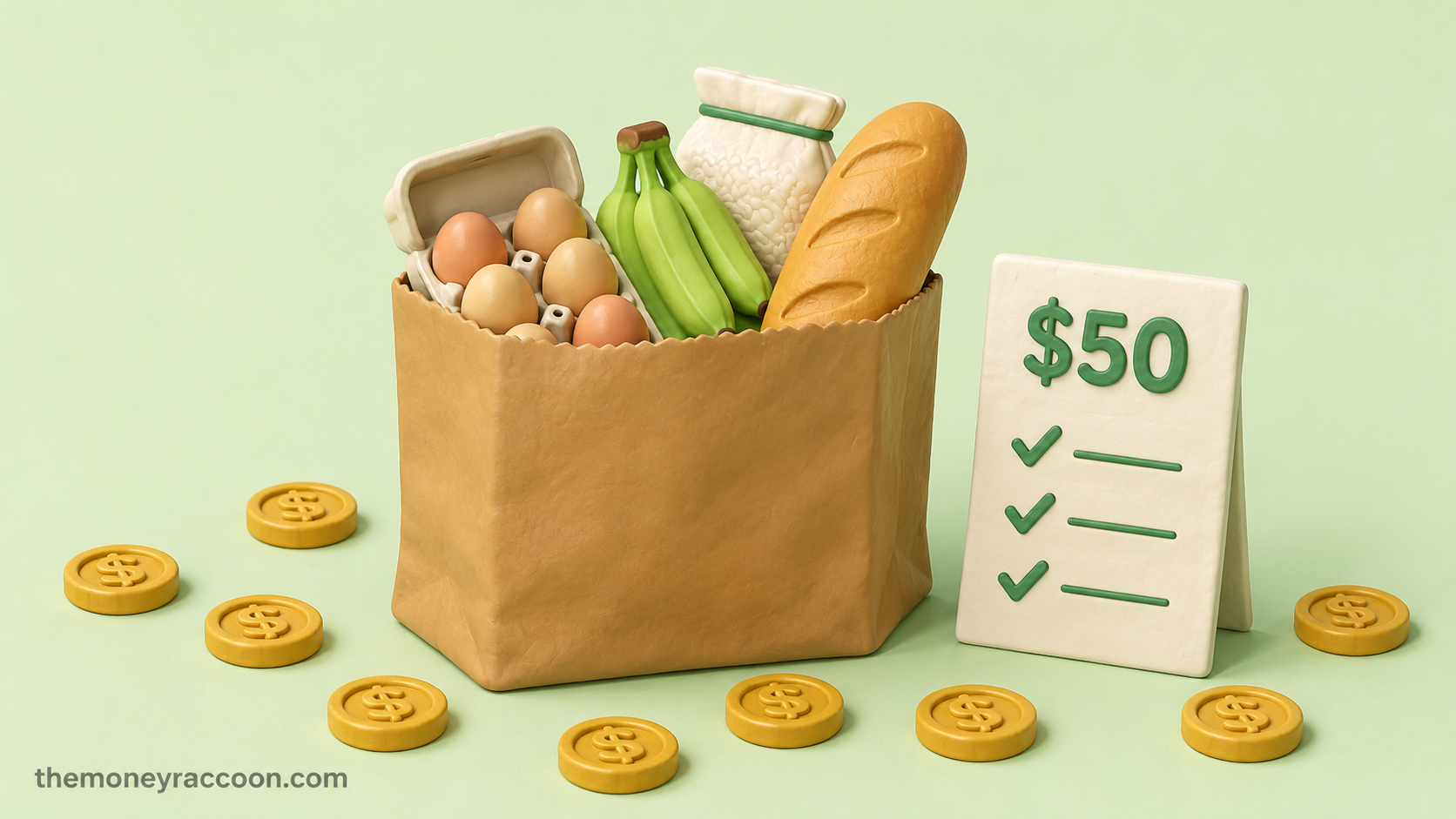
A $50-a-week grocery budget sounds like a punishment — celery, sad rice, and the constant hum of hunger. It isn’t. Done right, it’s three real meals a day for one person, with actual flavor and enough protein to feel human, for about $7 a day.
The trick was never eating less. It’s eating strategically: building meals around a handful of cheap, versatile staples, letting a few ingredients pull double duty across the week, and shopping a plan instead of wandering the aisles. Grocery prices climbed hard the last few years — this is how you claw the number back down without living on ramen.
Below is a complete, real one-week meal plan that lands at $50, the shopping list to match, the strategy so you can flex it forever, and how to scale it up for a family. Screenshot it and take it to the store.
The direct answer: A $50-a-week grocery budget for one person is realistic with planning: build meals around cheap staples (rice, beans, eggs, oats, frozen vegetables, chicken thighs, in-season produce), cook in batches, and let ingredients repeat across meals. That’s roughly $7/day for three meals. Families scale to about $50–60 per person per week with the same strategy.
The Strategy (Why $50-a-Week Grocery Budget Actually Works)
Five principles do all the heavy lifting. Learn these and you can rebuild the plan with whatever’s cheap near you:
- Build around cheap protein + cheap carbs. Eggs, chicken thighs, canned tuna, dried beans, and lentils are the cheapest protein per gram; rice, oats, and potatoes the cheapest filling carbs. Anchor every meal to one of each.
- Make ingredients repeat. A rotisserie-style batch of chicken thighs becomes dinner, then tomorrow’s lunch, then a soup. Buying one ingredient for one meal is what wrecks budgets.
- Shop the plan, not the store. Walking in without a list is how $50 becomes $85. Decide the week’s meals first, write the exact list, buy only that.
- Frozen and canned are your friends. Frozen vegetables are as nutritious as fresh, never spoil, and cost less. Canned beans and tomatoes are pantry gold.
- Buy produce in season and generic everything. Store-brand staples are 20–40% cheaper than name brands for identical food. In-season produce is a fraction of out-of-season.
The $50 Grocery Budget Meal Plan (One Full Week)
| Day | Breakfast | Lunch | Dinner |
|---|---|---|---|
| Mon | Oatmeal + banana | Egg fried rice | Chicken thighs + rice + frozen veg |
| Tue | Oatmeal + peanut butter | Leftover chicken wrap | Bean & veggie chili |
| Wed | Eggs + toast | Chili (leftover) | Pasta + canned tomato sauce |
| Thu | Oatmeal + banana | Tuna sandwich | Chicken & veggie stir-fry |
| Fri | Eggs + toast | Pasta (leftover) | Baked potatoes + beans + cheese |
| Sat | Pancakes (from staples) | Tuna & bean salad | Big veggie fried rice |
| Sun | Oatmeal + peanut butter | Loaded baked potato | Roast chicken thighs + potatoes |
Notice the machine: chicken thighs cover four meals, rice anchors three, beans and eggs fill the gaps, and nothing gets thrown away. That’s the whole secret to a $50 grocery budget — not deprivation, reuse.
The Shopping List (~$50)
The staples that produce the week above. Prices vary by store and city, but this basket lands near $50 at most budget grocers (Aldi, Walmart, Lidl):
| Category | Items |
|---|---|
| Protein | Chicken thighs (family pack), 18 eggs, 2 cans tuna, 1 bag dried beans |
| Carbs | Rice (2 lb), oats (large), pasta, bread, potatoes (5 lb) |
| Produce | Bananas, onions, frozen mixed vegetables (2 bags), in-season veg |
| Pantry | Canned tomatoes, peanut butter, cooking oil, basic spices, block of cheese |
Two rules at the register: buy the family/bulk pack of chicken and eggs (cheapest per unit — you’ll use it all), and grab store brand on every single item. Those two habits alone are the difference between $50 and $70. Track it in a cash envelope for groceries and the number stops drifting.
Scaling Up (and Squeezing Lower)
Feeding a family? The per-person cost drops with volume — bulk buying and batch cooking are more efficient at scale. Budget roughly $50–60 per person per week and multiply the plan; a family of four eats well on $200–240 with the same staples and bigger batches.
Want it even cheaper? Cashback apps (Ibotta, Fetch) rebate a few dollars per shop on items you’re already buying; a warehouse membership pays off for big households; and cooking dried beans instead of canned shaves more. Stack those and the effective number drops further.
And zoom out. Groceries are one lever — the bill-negotiation call frees another $50–150/month, and if the budget’s genuinely tight, here are 25 realistic ways to add income. Cutting the grocery bill and growing the income are the same goal from two directions.
FAQ: $50-a-Week Grocery Budget
- Is a $50-a-week grocery budget realistic in 2026? For one person, yes — with planning. It requires cooking at home, buying staples and store brands, and reusing ingredients across meals. It’s not effortless, but it’s genuinely doable and delivers three real meals a day at about $7/day. Zero dining out is the assumption that makes it work.
- What should I buy on a tight grocery budget? Cheap protein (eggs, chicken thighs, canned tuna, dried beans), cheap carbs (rice, oats, potatoes, pasta), frozen vegetables, and pantry staples (canned tomatoes, peanut butter, oil, spices). These combine into dozens of meals and rarely spoil.
- How do I feed a family of four on a budget? Budget around $50–60 per person per week ($200–240 total) and use the same staples in bigger batches — per-person cost actually drops with volume. Batch-cook, buy family packs, and let meals repeat as leftovers to cut waste.
- How can I lower my grocery bill without couponing? Shop with a plan and list, buy store brands (20–40% cheaper), choose in-season produce, use frozen vegetables, buy protein in bulk packs, and cook at home. These beat coupon-clipping for effort-to-savings and work every week automatically.
- What’s the cheapest healthy food to buy? Dried beans and lentils, eggs, oats, rice, potatoes, frozen mixed vegetables, and in-season produce give you the most nutrition per dollar. They’re the backbone of virtually every low-cost, healthy meal plan.
The meal plan and shopping list are original to The Money Raccoon, built around budget-grocer staple pricing (Aldi, Walmart, Lidl). Nutrition and portion guidance cross-checked against the USDA’s Thrifty Food Plan. Prices vary by region and season — adjust to your local store.

Personal finance writer, founder and editor of The Money Raccoon — 5 years in the industry and 1,000+ articles published in the finance niche. I turn complex money rules — credit scores, debt, banking and investing — into plain-English guides backed by primary sources and real numbers. Every guide here is fact-checked against the institutions that publish the data and updated when the numbers change.