
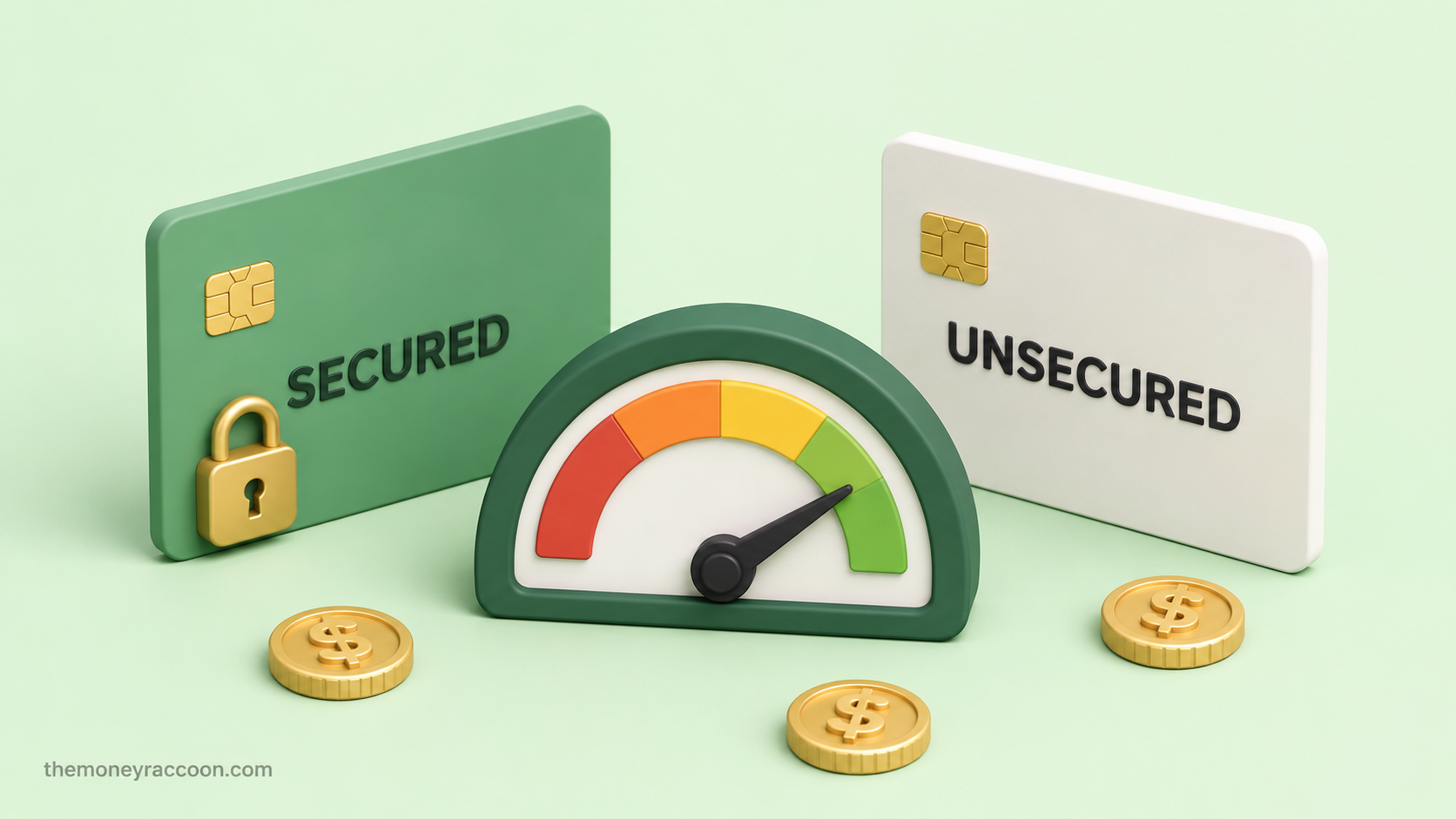
The secured vs unsecured credit card question comes up at the exact moment it matters most: when your credit is damaged or nonexistent, and you need a card that will rebuild it — not another rejection letter.
Here’s the twist most articles bury: to the credit bureaus, the two cards look identical. A secured card reports your payments exactly like an unsecured one; your score doesn’t know or care that a deposit sits behind it. The real differences live elsewhere — who gets approved, what it costs, and how quickly you can graduate to better products.
So this comparison answers the question people are actually asking: which one gets you, with your credit situation, to a healthy score fastest — and how to run the rebuild so it takes months instead of years.
The quick version: A secured credit card requires a refundable deposit (usually $200+) that becomes your credit limit; an unsecured card doesn’t. Both report to the credit bureaus identically, so neither builds credit “faster” per dollar of on-time payment — but secured cards approve almost anyone, while unsecured cards for bad credit often carry high fees and rates. For damaged or thin credit, a no-fee secured card is usually the faster practical path: guaranteed approval today beats months of rejections, and most graduate to unsecured within 6–18 months.
Secured vs. Unsecured, Side by Side
| Secured Card | Unsecured Card | |
|---|---|---|
| Deposit required | Yes — refundable, usually $200+ (becomes your limit) | No |
| Approval with bad/no credit | Very easy — deposit removes the bank’s risk | Hard; “bad credit” versions exist with high fees |
| Reports to credit bureaus | ✅ Yes — identically | ✅ Yes |
| Builds credit | ✅ Same speed per on-time payment | ✅ Same speed |
| Typical cost | Many have $0 annual fee | Rebuild-market cards often charge $50–100+/yr |
| Credit limit | = your deposit ($200–2,500) | Set by issuer; can be higher |
| Graduation | Many upgrade to unsecured + refund deposit in 6–18 months | — |
Read the middle rows twice: the bureaus receive the same data from both. The “which builds faster” question is really “which one can you get approved for, at what cost, starting today.”
Secured vs Unsecured Credit Card: Which Should YOU Get?
The honest decision tree:
Score below ~580, or no credit history → secured, almost every time. Approval is near-guaranteed (the deposit is the bank’s safety net), no-annual-fee options are plentiful, and every on-time month builds your file exactly as an unsecured card would. The deposit isn’t a fee — you get it back at graduation or closure. It’s a credit-building tool you lend money to.
Score 580–660 → compare carefully. You may qualify for entry-level unsecured cards, but this range is where the rebuild-market predators live: sub-prime unsecured cards with $75–100 annual fees, monthly “maintenance” charges, and 30%+ APRs. Rule of thumb: a $0-fee secured card beats a fee-heavy unsecured card, because fees are a guaranteed loss while the deposit is refundable. Only take the unsecured if the total fees are near zero.
Score 660+ → unsecured, and aim higher. You likely qualify for mainstream cards with no fees and real rewards. A secured card at this level is unnecessary friction.
Rebuilding after collections or charge-offs? Clean the report while you build: removing collections plus 6 months of on-time payments on a secured card is the classic one-two punch of credit repair.
How to Make Either Card Rebuild Credit FAST
The card is the vehicle; how you drive it sets the speed. Four rules turn 6 months of card use into maximum score gain.
- 1. Keep utilization under 10%. On a $200-limit secured card, that means carrying under $20 when the statement cuts. Utilization is a huge scoring factor, and small limits make it brutally easy to look “maxed out” — one tank of gas can be 30% utilization. Charge something small and recurring (one subscription), autopay it in full, done.
- 2. Never miss — automate it. Payment history is the single biggest factor. Autopay the full balance; a single 30-day late on a rebuild card undoes months of progress.
- 3. Ask about graduation at month 6. Many secured issuers review accounts automatically, but a call asking “when am I eligible to graduate to unsecured?” can accelerate it. Graduation returns your deposit and usually raises your limit — instantly improving utilization.
- 4. Don’t close the card after graduating. Age of accounts matters; your first rebuild card becoming your oldest account is a long-term asset. Keep it open with the one small subscription on autopay.
- Run those four for 6–12 months and the typical rebuild lands 60–100+ points — enough to change what you pay for a car loan by thousands. The complete score playbook, beyond the card, is here.
The Rebuild-Market Traps
Three products dressed as help that mostly harvest desperate applicants:
Fee-stacked “bad credit” unsecured cards. $95 annual fee + $8 monthly maintenance on a $300 limit means you paid $191/year for $109 of usable credit. The math never works; a free secured card does the same rebuilding for $0.
Cards that don’t report to all three bureaus. The entire point is the reporting. Before applying, confirm the card reports to Equifax, Experian and TransUnion — some subprime and “shopping club” cards don’t, making them useless for rebuilding.
“No credit check” rent-a-score schemes. If a product’s pitch is boosting your score without any real credit activity, the boost is usually shallow, temporary, or invisible to real lenders. On-time payments on a real, reporting card remain the only engine that matters. (And yes, BNPL now counts too — manage it with the same discipline.)
FAQ: Secured vs Unsecured Credit Card
- Does a secured credit card build credit as fast as an unsecured card? Yes — identically. Both report your payment history and utilization to the bureaus the same way, and your score doesn’t distinguish them. The practical difference is approval odds and cost, not building speed.
- How long does it take to graduate from a secured card? Typically 6–18 months of on-time payments, depending on the issuer. Many banks review automatically; asking at month 6 can speed it up. Graduation refunds your deposit and converts the account — keeping its age history intact.
- Do you get your secured card deposit back? Yes — it’s refundable when you graduate to unsecured or close the account in good standing. The deposit is collateral, not a fee; the only way to lose it is defaulting on the balance.
- Can a secured card be denied? Rarely, but yes — usually for an unpaid balance still owed to that same bank, a very recent bankruptcy, or inability to verify identity/income. Even then, other issuers’ secured cards typically remain available.
- What credit score do you need for an unsecured credit card? Entry-level unsecured cards start approving in the low 600s; solid no-fee cards with rewards generally want 660+. Below ~580, secured is realistically the available lane — and per payment, it builds exactly as fast.
Sources: CFPB — How to rebuild your credit, CFPB — Secured credit cards, Experian — Secured vs. unsecured credit cards

Personal finance writer, founder and editor of The Money Raccoon — 5 years in the industry and 1,000+ articles published in the finance niche. I turn complex money rules — credit scores, debt, banking and investing — into plain-English guides backed by primary sources and real numbers. Every guide here is fact-checked against the institutions that publish the data and updated when the numbers change.