
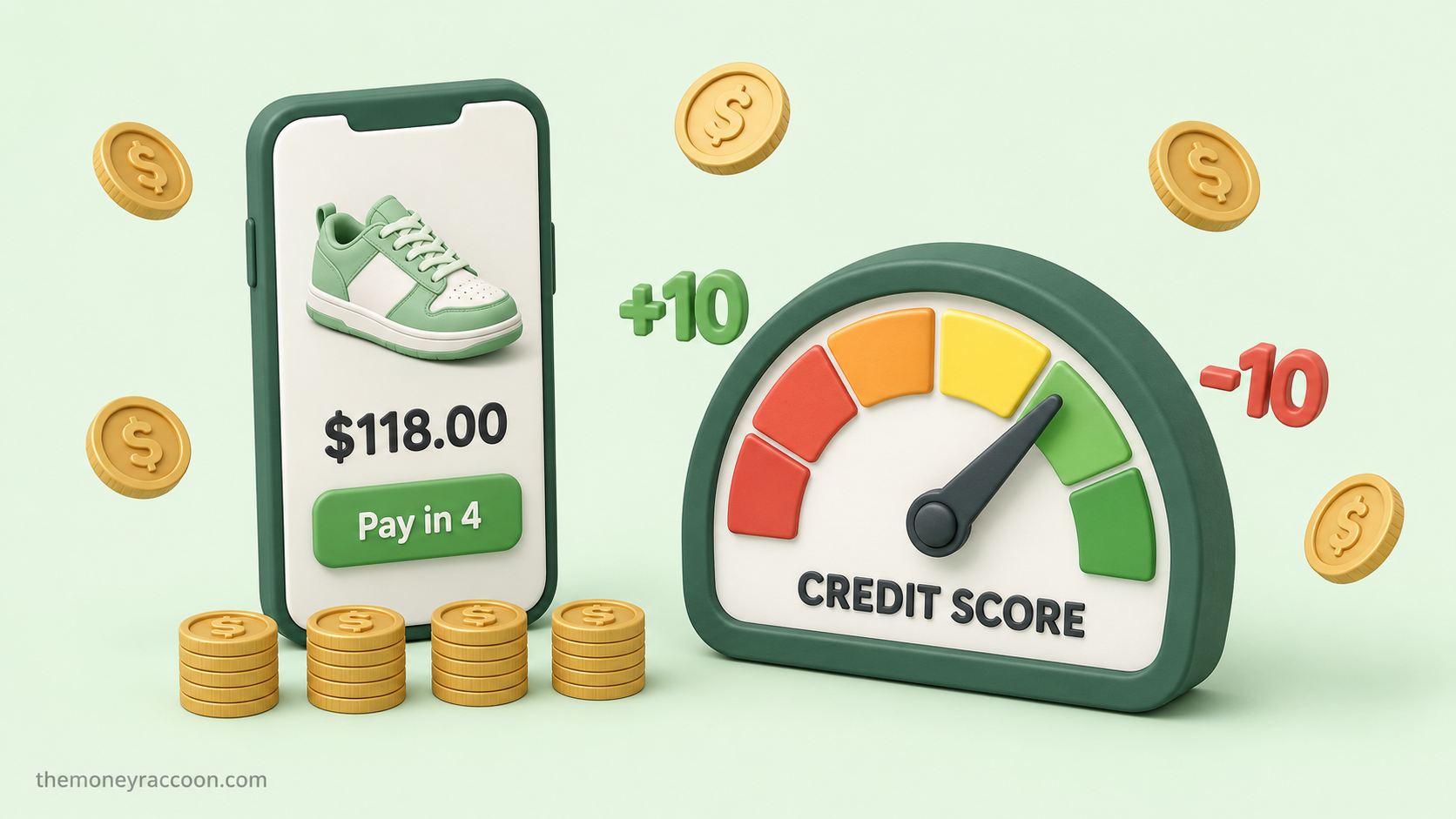
A few weeks ago I split a $118 pair of running shoes into four payments. The approval took maybe eight seconds.
My own bank, which has known me for years, still wants a phone call and two business days to raise my card limit by $200 — but a company I’d never interacted with in my life lent me money before the checkout page finished loading. Which raises the question half of America seems to be googling lately: does buy now pay later affect your credit score?
Nobody at checkout says the word “loan.” The button says something friendly like 4 interest-free payments. But a loan is what it was.
And this year, for the first time, there’s a real chance that loan showed up on a credit report. Not in some hypothetical future. Now. Affirm already reports these things. FICO already built scores that count them. The blind spot where buy now, pay later used to live is closing, and a lot of people are going to find out the hard way, probably around the time they apply for a car loan.
So let’s get you ahead of it.
The direct answer: Yes — buy now, pay later can now affect your credit score. Affirm reports all of its loans, including Pay in 4, to Experian and TransUnion. FICO’s newest scores (FICO Score 10 BNPL and 10 T BNPL) factor that data in. Pay on time and it can help. Miss payments and it hurts.
What Changed: FICO Now Has BNPL-Specific Scores
In the fall of 2025, FICO released two new scoring models. FICO Score 10 BNPL and FICO Score 10 T BNPL, if you want the full names — nobody does. What matters is what they do: for the first time, a major credit score formally counts your buy now, pay later activity.
How many plans you’ve opened. How often. Whether you actually pay them.
Now, before anyone panics: FICO tested this on real consumers, and for about 85% of people with a BNPL account, the score moved less than 10 points in either direction. Most saw nothing at all, or a small bump up. This was not the credit-score apocalypse some headlines wanted it to be.
The interesting movement happened at the edges. People with thin credit files who paid every installment on time saw scores rise — FICO specifically found that folks with five or more Affirm loans, handled well, came out stable or better. Meanwhile the people who missed payments found out that a skipped $30 installment now behaves an awful lot like a skipped credit card payment.
Which, honestly, is fair. It was always debt. The report just finally admits it.
Which BNPL Apps Report to the Credit Bureaus?
Wouldn’t it be nice if there were one rule? There isn’t. Every company does its own thing, and the differences are big enough to matter:
| BNPL Provider | What Gets Reported | Which Bureaus | Since |
|---|---|---|---|
| Affirm | All loans — including Pay in 4 | Experian, TransUnion | April–May 2025 |
| Klarna | Longer financing plans (6–36 months) only. Pay in 4 is NOT reported | Experian, TransUnion | Ongoing |
| Afterpay | Nothing — does not report to U.S. bureaus | None | — |
| Other apps (PayPal, Zip, Sezzle) | Varies by product — check the loan terms before you borrow | Varies | Varies |
Affirm went all in. Since spring 2025, every single Affirm loan — down to the interest-free four-payment plans — lands on your Experian and TransUnion reports with the balance, the terms, the payment history, all of it. If you use Affirm regularly, your credit report already knows things about your sneaker habit that your spouse might not.
Klarna split the difference. The long financing plans report; the everyday Pay in 4 doesn’t. Afterpay reports nothing at all. And the industry as a whole keeps moving toward more reporting, not less.
One warning about that word, “nothing,” though. Not reporting your payments is not the same as your payments having no consequences. Let an Afterpay balance go unpaid long enough and it gets sold to a collections agency, and collections agencies most definitely report to credit bureaus.
There is no BNPL company on earth whose debt you can simply ignore. And if a collection has already landed on your report, here’s how to remove collections from your credit report — often without paying.
The Upside Nobody Expected
Strange as it sounds, this change might be the best free credit-building tool to come along in years — specifically for people the credit system has always ignored.
Think about who has a “thin file”: students, recent immigrants, anyone who spent their twenties avoiding credit cards because they watched a parent drown in one. The traditional advice for these folks involves secured cards (bring $200 as a deposit) or credit-builder loans (pay interest for the privilege). Both work. Both also cost money.
BNPL now offers a third path. You were buying the shoes anyway. If your provider reports — and Affirm does — every on-time installment quietly becomes evidence that you pay your debts. FICO’s own testing backs this up: responsible BNPL users with multiple loans tended to see scores hold steady or climb.
Free. No deposit. Built from purchases that were happening regardless.
I’m not telling you to go shopping to build credit. That’s how the trap works, and we’ll get to the trap in a second. But if BNPL is already part of your life, it’s now working for you instead of just floating in a void. If you’re after a bigger jump, our guide on how to raise your credit score 100 points stacks all the levers in one place.
The Part Where It Goes Wrong
Missed payments, first. Under the new models a missed installment can ding your score much like a missed card payment would. Let that sink in: the $29.50 you forgot because the debit card on file expired? That has real power now. Over something that cost less than dinner.
Then there’s stacking, which is sneakier. Every BNPL purchase is its own separate loan. Buy four things in a month and congratulations, you’ve opened four loans. A credit file that suddenly sprouts eight or ten brand-new accounts looks risky to any scoring model, on-time payments or not — it drags down your average account age and pattern-matches to someone in trouble.
And underneath both of those sits the actual problem, the one the industry is built on: splitting a price into four pieces makes your brain stop counting it as spending. $100 feels like money. “Four payments of $25” feels like nothing. Stack a few of those nothings and you’re carrying $400 a month in installments, one thin paycheck away from your first miss.
My rule, and you can steal it: if I wouldn’t put a purchase on a credit card, it doesn’t go on BNPL either. Same debt. Friendlier font.
Will Lenders Actually See This?
Depends on the lender, and this is the nuance most coverage skips.
Banks now get a choice between score versions — one that includes BNPL data, one that doesn’t. Big lenders adopt new models at the speed of continental drift. Most mortgage lenders are literally required to use FICO versions that predate all of this. So no, the loan you took out for a mattress in March is probably not what sinks your mortgage application this year.
But notice the direction everything is moving. The data is already being collected. The scores already exist. Adoption only ever goes one way. So does buy now pay later affect your credit score with every lender today? Not yet — but treat it like it counts everywhere, because piece by piece, lender by lender, it will.
Five Rules That Keep “Buy Now, Pay Later” Harmless
- Autopay. Everything. Always. The single biggest risk is a forgotten installment, and autopay deletes it — as long as the funding account isn’t empty, so check that too.
- One provider, period. Plans scattered across Affirm, Klarna and Zip mean three apps, three payment rhythms, three chances to lose track.
- Two open plans, max.Add up every installment and put the total in your budget as one line item. If the number makes you flinch, that’s information. (LINK INTERNO quando a budget spreadsheet sair.)
- Actually look at your credit reports. Your BNPL loans might already be on them. Pull your free reports at AnnualCreditReport.com and make sure everything listed is accurate — bureaus make mistakes constantly, and you can dispute them. (Medical bills on your report? Those play by a completely different set of rules.)
FAQ: Does Buy Now Pay Later Affect Your Credit Score?
Does Klarna affect your credit score? The everyday Pay in 4 plans? No — Klarna doesn’t report those to U.S. bureaus, so they can’t help or hurt you. Its longer financing plans (6 to 36 months) are a different story: those show up on Experian and TransUnion like any other loan.
Does Afterpay report to credit bureaus? No, Afterpay reports nothing as of 2026. The catch: unpaid Afterpay debt can still get sent to collections, and that lands on your report and does real damage.
Do payment plans hurt your credit? It depends on the plan and the provider. BNPL “pay in 4” plans only hurt if they’re reported (Affirm reports; Klarna’s Pay in 4 doesn’t) or if missed payments go to collections — which always hurts. Longer financing plans generally report like regular loans: on-time helps, missed payments damage. The plan itself isn’t the risk; unreported-until-collections debt is.
Does Bill Me Later build credit? Bill Me Later became PayPal Credit, and it generally doesn’t report regular activity to the credit bureaus — so on-time payments there build nothing. Like all “Buy Now, Pay Later” -style products, though, defaulted balances can be sent to collections, which absolutely does hit your report. Building credit requires products that report: credit cards, loans, or BNPL providers like Affirm that report everything.
Do “Buy Now, Pay Later” apps do a hard credit pull? For Pay in 4, almost never — it’s usually a soft check you’ll never feel. Longer financing can involve a hard inquiry. The app has to tell you before you confirm, so read that screen instead of tapping through it.
Can I build credit with buy now, pay later? If your provider reports, yes. Affirm reports everything to Experian and TransUnion, so a run of on-time payments genuinely builds your file — especially useful if you’re starting from thin. Klarna Pay in 4 and Afterpay build nothing.
What happens if I miss a “Buy Now, Pay Later” payment? Usually in this order: a late fee, then a mark on your credit report (if your provider reports), and eventually collections if it goes unpaid — which hurts your score no matter which app it started in.
Where these numbers come from: FICO, Bankrate, Empower, Payments Dive

Personal finance writer, founder and editor of The Money Raccoon — 5 years in the industry and 1,000+ articles published in the finance niche. I turn complex money rules — credit scores, debt, banking and investing — into plain-English guides backed by primary sources and real numbers. Every guide here is fact-checked against the institutions that publish the data and updated when the numbers change.