
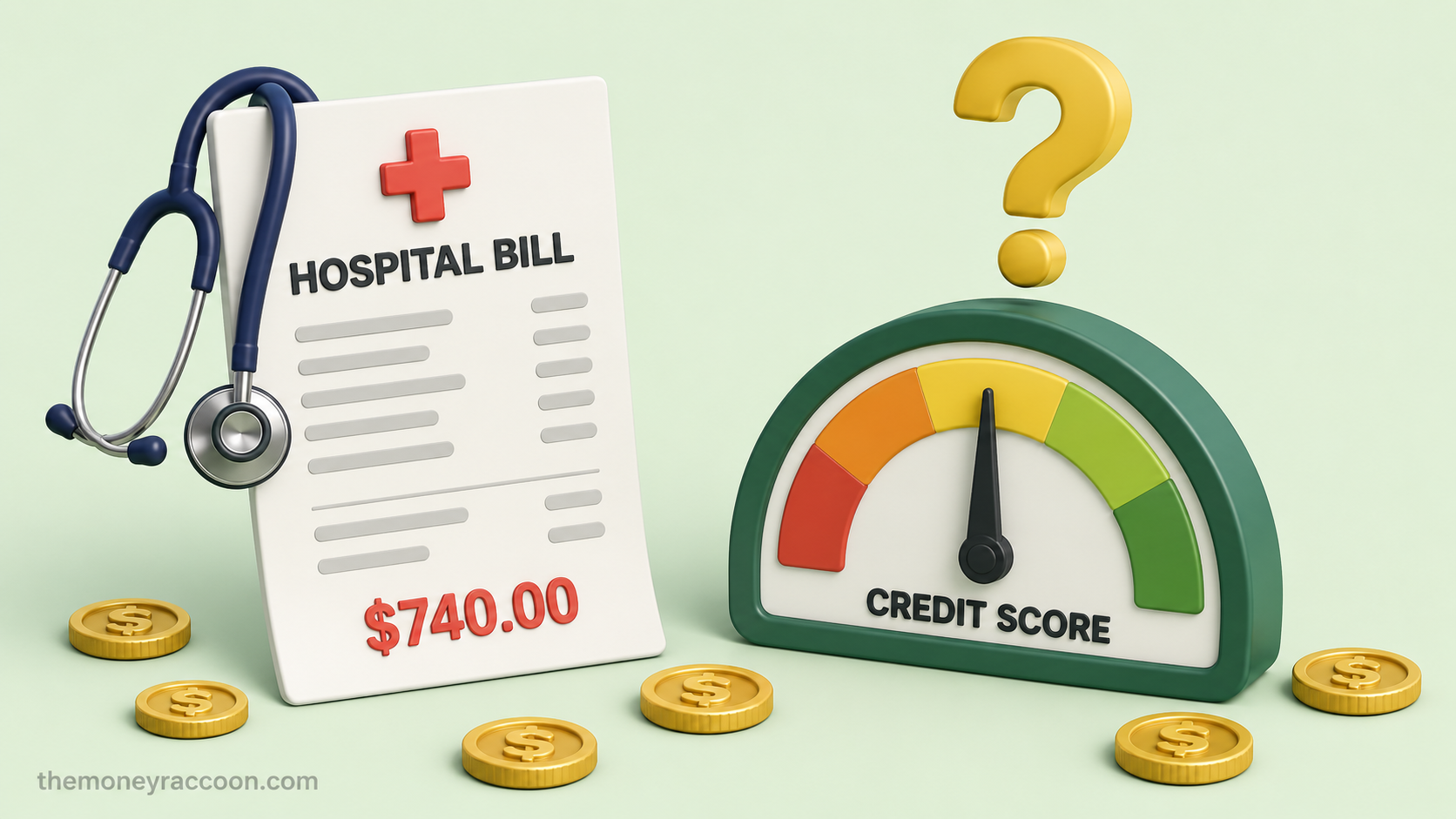
If you’ve been trying to answer one simple question — does medical debt affect your credit score? — I don’t blame you for being confused. The rules changed. Then they changed back. Then fifteen states wrote their own rules, and now the federal government is fighting those too.
Quick recap of the chaos: in January 2025, federal regulators finalized a rule that would have wiped medical debt off credit reports entirely — all of it, for roughly 15 million Americans. Six months later a federal judge in Texas killed the rule before it ever took effect. Then a bunch of states said fine, we’ll pass our own bans. And as of late 2025, Washington is arguing those state bans shouldn’t count either.
Meanwhile you’re just sitting there with a $740 bill from an ER visit, trying to get a straight answer to one question: does medical debt affect your credit score or not?
Here’s the straight answer.
The two-minute answer: Sometimes. In 2026, medical debt under $500 never appears on your credit report, paid medical collections are removed, and no medical bill can show up until it’s been in collections for 12 months. Unpaid medical debt over $500, older than a year, can hurt your score — unless you live in one of 15 states that ban it.
The Two-Minute History of a Very Messy Rule
You don’t need the full saga, but knowing the timeline helps you spot outdated advice online — and there is a lot of outdated advice on this topic right now.
| When | What Happened | Status Today |
| 2022–2023 | The three credit bureaus voluntarily removed paid medical collections, anything under $500, and added a 12-month waiting period | ✅ Still in effect |
| January 2025 | CFPB finalized a rule banning ALL medical debt from credit reports | ❌ Never took effect |
| July 2025 | A federal court vacated the rule, calling it beyond the agency’s authority | Rule is dead |
| 2025–2026 | 15 states passed their own laws restricting medical debt reporting | ✅ In effect, but under federal challenge |
| October 2025 | CFPB declared federal law preempts those state laws | ⚖️ Legal fight ongoing |
The takeaway: the big federal ban you may have read about in early 2025? It never happened. But the quieter protections from 2022–2023 survived everything — and honestly, they do most of the heavy lifting anyway. So, does medical debt affect your credit score in 2026? Only in a narrow set of cases — and the next three rules are why.
The Three Protections That Apply Everywhere
No matter which state you live in, these three rules stand in 2026. They’re voluntary policies of Equifax, Experian and TransUnion — not laws — but all three bureaus follow them.
1. Debt under $500 doesn’t get reported. Period. That ER copay, the lab work, the ambulance ride that somehow billed separately — if the collection is under $500, it never touches your credit report. This one change erased about half of all medical collections when it took effect.
2. Paid medical collections disappear. This is a bigger deal than it sounds. With almost every other kind of debt, paying a collection doesn’t remove it — the record stays on your report for years, just marked “paid.” Medical debt is the exception. Pay it and it’s gone, completely, like it never existed.
3. Nothing shows up for 12 months. Medical bills can’t appear on your report until they’ve been sitting in collections for a full year. That grace period exists because medical billing is a slow-motion disaster — insurance disputes, resubmissions, bills that arrive eight months late. The waiting period gives you time to fight it out with your insurer before your credit takes the hit.
Add those up and the practical reality is this: most medical bills never touch most people’s credit reports. The danger zone is specific — unpaid, over $500, more than a year old.
The 15 States Where Medical Debt Can’t Touch Your Credit
Some states didn’t wait for Washington to figure things out. If you live in one of these, state law restricts or outright bans medical debt from appearing on your credit report — protections stronger than the federal baseline:
| California | Maine | Oregon |
| Colorado | Maryland | Rhode Island |
| Connecticut | Minnesota | Vermont |
| Delaware | New Jersey | Virginia |
| Illinois | New York | Washington |
One honest caveat, because this is where it gets legally weird: in October 2025 the CFPB declared that federal law overrides these state protections, and that fight is still working through the courts. As of right now, the state laws stand and the bureaus are following them. If that changes, we’ll update this article — check the date at the top.
When Does Medical Debt Affect Your Credit Score?
So who actually gets hurt in 2026? The bill has to clear every one of these bars:
- It’s over $500
- It’s gone unpaid for more than 12 months
- It’s in collections
- And you live in one of the 35 states without extra protections
Clear all four and yes — that collection lands on your report and drags your score down, sometimes significantly.
There’s also a sneaky detail hiding in the scoring models themselves. The newer ones (FICO 9 and later, VantageScore 3.0 and 4.0) either ignore medical collections entirely or weigh them much less than other debt. Great. Except mortgage lenders are still required to use FICO models from the early 2000s — models that treat a medical collection like any other collection. So the same unpaid hospital bill might barely matter when you apply for a credit card and hit hard when you apply for a home loan. If a mortgage is in your near future, medical collections deserve your attention first. (Speaking of scoring models changing under your feet: FICO’s newest scores now track buy now, pay later loans too.)
And one more thing that surprises people: your doctor or hospital never reports you directly. Providers don’t talk to credit bureaus. The damage only starts if your bill gets sold to a collections agency — which means the window between “bill arrives” and “bill goes to collections” is where all your power is.
Found Medical Debt on Your Report? Do This, in This Order
- Check if it should even be there. Under $500? Already paid? Less than 12 months old? Then it’s violating bureau policy and you can dispute it for removal — these errors are common. Pull your free reports at AnnualCreditReport.com to see exactly what’s listed.
- Make sure it’s actually yours and actually correct. Medical billing errors are rampant. Request an itemized bill from the provider and match it against what insurance already covered. People routinely get billed for things insurance paid months ago.
- Dispute errors in writing with the bureaus. Not by phone. A written dispute forces a formal investigation, usually within 30 days — and we have a free template below.
- If the debt is real, negotiate before paying. Ask the hospital about financial assistance — nonprofit hospitals are legally required to have these programs and most people never ask. Offering a lump-sum settlement for less than the balance is normal and expected.
- Whatever you do, don’t put it on a credit card. The moment a medical bill becomes credit card debt, it loses every protection on this page — the $500 floor, the removal-when-paid, the state laws, all of it. It becomes ordinary card debt at 24% interest. This is the single most expensive mistake in medical debt, and billing offices will happily let you make it.
FAQ: Medical Debt and Your Credit
Does paying off a medical collection remove it from my credit report? Yes — this is the rare good news in credit reporting. All three bureaus remove paid medical collections completely. Unlike other debts, there’s no “paid collection” scar left behind.
Can a hospital report me directly to the credit bureaus? No. Hospitals and doctors don’t report to bureaus. Your bill only threatens your credit if it’s sold to a collections agency, and even then it can’t appear for 12 months.
How long does medical debt stay on your credit report? If it qualifies to appear at all (unpaid, over $500, past the grace period), it can stay up to seven years — but pay it and it comes off immediately under current bureau policy.
Does medical debt affect buying a house? More than it affects almost anything else. Mortgage lenders still use older FICO models that count medical collections at full weight. If you’re planning to buy, resolving medical collections should jump to the top of your list.
Should I pay a medical bill with a credit card? Almost never. Card debt has none of the protections medical debt has — no removal when paid, no $500 minimum, no state law shields, plus interest. Negotiate the bill, set up a payment plan with the provider, or apply for financial assistance instead.
Data sources: CFPB, Brownstein Hyatt, NCLC, Consumer Reports

Personal finance writer, founder and editor of The Money Raccoon — 5 years in the industry and 1,000+ articles published in the finance niche. I turn complex money rules — credit scores, debt, banking and investing — into plain-English guides backed by primary sources and real numbers. Every guide here is fact-checked against the institutions that publish the data and updated when the numbers change.