
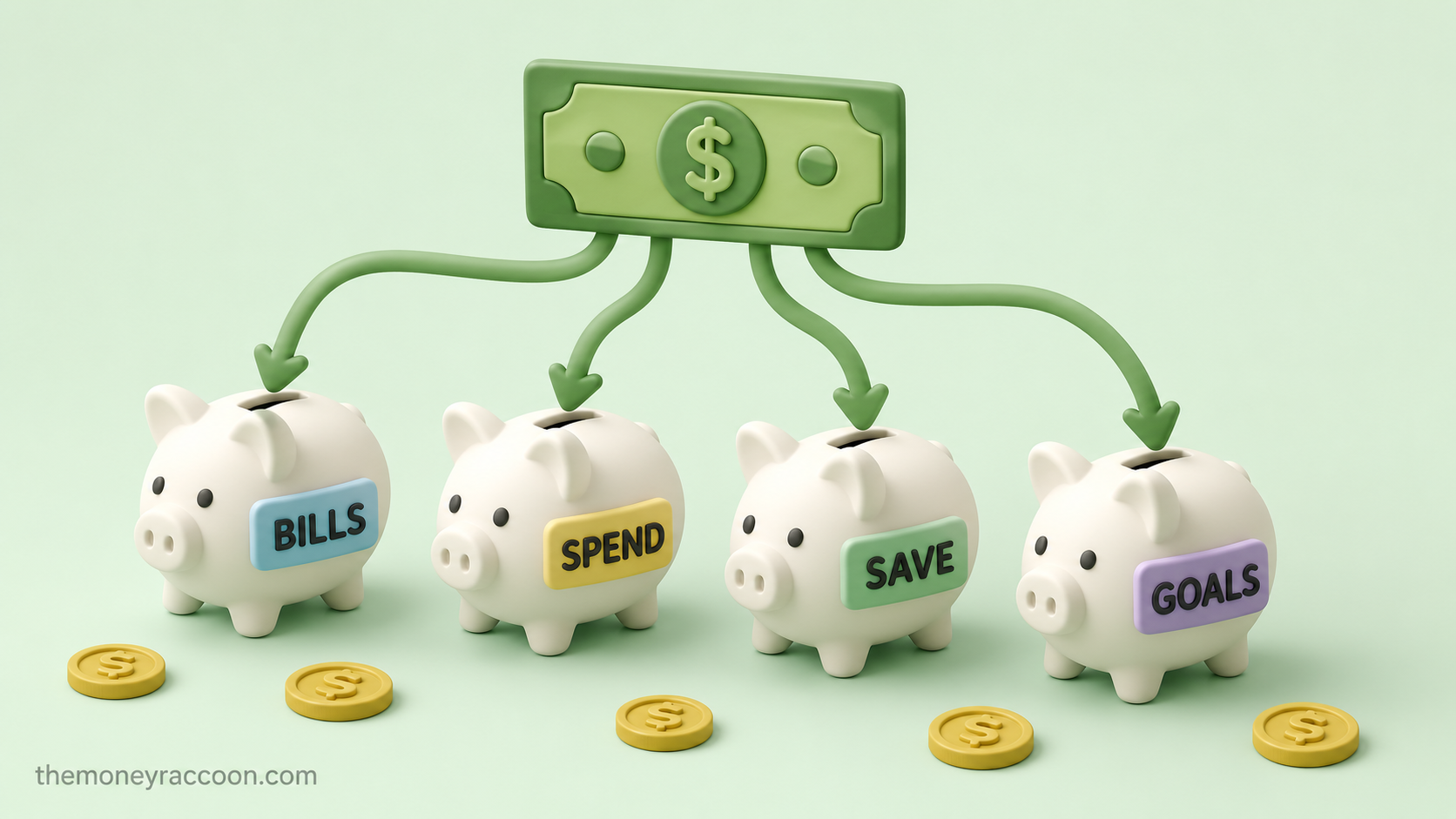
“How many bank accounts should I have?” sounds like a trivia question. It’s actually a design question — because the number of accounts you have quietly decides how your money behaves.
One account for everything means your rent money, your fun money, and your emergency money all swim in the same pool, and your brain has to referee every purchase against every priority at once. That’s how “I should have enough” becomes an overdraft. Twelve accounts means you’ve built a part-time job for yourself.
The sweet spot, for most people, is four — each with one job, connected by automatic transfers, so the system runs itself. We call it the 4-Account System, it takes about an hour to set up, and it’s the closest thing personal finance has to putting your money on rails. Here’s the full blueprint.
In one paragraph: Most people do best with four bank accounts: (1) a Bills checking account for fixed expenses on autopay, (2) a Spending checking account with its own debit card for everyday life, (3) an Emergency high-yield savings account, and (4) a Goals high-yield savings account for planned targets. Paychecks land in Bills, automatic transfers feed the rest — one hour of setup, then the system runs itself.
The 4-Account System
| Account | Type | Its One Job | What Lives Here |
|---|---|---|---|
| 1. Bills | Checking | Pay fixed costs on autopay | Rent, utilities, insurance, subscriptions, debt payments |
| 2. Spending | Checking (own debit card) | Everyday variable life | Groceries, gas, fun, eating out |
| 3. Emergency | High-yield savings | Sit there, untouched, earning | 3–6 months of expenses (build to it) |
| 4. Goals | High-yield savings | Fund planned targets | Vacation, car, down payment, holidays |
The flow that makes it automatic: your paycheck lands in Bills. The day after payday, two automatic transfers fire: your spending allowance moves to Spending, and your savings amount splits into Emergency and Goals. What remains in Bills covers the fixed costs on autopay — because you sized it that way once, during setup.
Result: the money in Spending is genuinely spendable — bills are already covered, savings already happened. No mental math at the register, ever again. It’s the envelope system’s logic, rebuilt in bank accounts with automation instead of cash.
How Many Bank Accounts Should I Have — Why Four Wins
Why not one? Because one account forces every dollar to be every kind of money at once. Studies of behavior aside, you’ve lived it: the balance says $1,900, but how much is actually free after rent clears and the car insurance hits? One-account people answer that question with anxiety and occasional overdrafts. Four-account people answer it by glancing at Spending.
Why not two (the classic checking + savings)? It’s better than one, but it still mixes bills with daily spending — the two categories that most need separating, because one is sacred and the other is flexible. And a single savings account blurs “don’t touch” emergency money with “meant to be spent” goal money, which is exactly how emergency funds leak into vacations.
Why not seven? Diminishing returns and rising admin. Each extra account adds login fatigue, minimum-balance watching, and transfer complexity. Four covers every distinct job money has; beyond that you’re organizing for sport. (One clean exception: a fifth account for business/side-hustle income if you have it — keeping that separate is tax hygiene, not overkill.)
The bonus nobody mentions: FDIC insurance covers $250,000 per depositor, per bank — so spreading accounts across two banks (checking pair at one, savings pair at another) also spreads your coverage and your access if one bank has an outage.
Setting It Up (One Hour, Once)
Step 1 — Choose the homes. Bills + Spending work great at one bank (instant transfers between them); Emergency + Goals belong at a high-yield online bank — where savings earn 10x the average and the slight friction of transferring back actually protects the money. All four can be $0-fee, $0-minimum — the 10-minute opening process is here, and if you’re opening new accounts anyway, grab a bank bonus for doing it.
Step 2 — Size the Bills account. List your fixed monthly costs (rent, utilities, insurance, subscriptions, debt payments). That total + a 10% buffer is what stays in Bills each month. This 20-minute list is the only real work in the whole system.
Step 3 — Point everything at its account. Paycheck → Bills. Every autopay → Bills. Debit card in your wallet → Spending only. (The Bills card stays in a drawer.)
Step 4 — Automate the split. Schedule transfers for the day after payday: Bills → Spending (your allowance) and Bills → Emergency/Goals (your savings rate — even $50 counts to start). Automatic beats motivated, every single month.
Step 5 — The 10-minute monthly check. Glance at all four on the 1st: Bills buffer intact? Spending pace okay? Savings growing? Adjust one number if needed. That’s the entire maintenance.
Mistakes and Tweaks
- Don’t keep all four at one bank just for convenience — the Emergency fund especially benefits from being one deliberate transfer away, not one impulsive tap.
- Don’t skip the buffer in Bills — the 10% cushion is what makes autopay safe.
- Don’t open accounts with fees to build the system — every piece exists in $0-fee versions.
- Couples variant: shared Bills + shared Goals, individual Spending accounts each — the most argument-proof money setup ever devised.
- Debt-heavy variant: while attacking debt hard, Goals can pause and its transfer redirects to the payoff — the structure flexes without breaking.
FAQ: How Many Bank Accounts Should I Have
- Is it bad to have multiple bank accounts? No — checking and savings accounts don’t affect your credit score, and there’s no penalty for having several. The only real costs are potential monthly fees (avoidable with $0-fee banks) and your own attention. Structured well, multiple accounts reduce money stress rather than add it.
- How many bank accounts is too many? When you can’t name each account’s job in one sentence, or you’re paying fees, or you’ve missed something because of the sprawl — you have too many. For most people that line sits around five or six; the 4-Account System stays comfortably under it.
- Should checking and savings be at different banks? Ideally yes: keep Bills + Spending at one bank for instant transfers, and Emergency + Goals at a high-yield online bank for 10x the interest — plus the healthy friction of a 1-day transfer that protects your emergency fund, and broader FDIC coverage across institutions.
- Do multiple bank accounts affect your credit score? No — bank accounts aren’t credit products and never appear on your credit report. Banks may check ChexSystems (banking history) when you open one, but that’s separate from credit and opening accounts doesn’t lower your score.
- How much should I keep in each account? Bills: one month of fixed costs + 10% buffer. Spending: your monthly variable allowance. Emergency: build toward 3–6 months of essential expenses. Goals: whatever your targets need, on schedule. The exact numbers matter less than each account having a defined job.
The 4-Account System framework is original to The Money Raccoon. Deposit insurance details: FDIC — Deposit insurance FAQ.

Personal finance writer, founder and editor of The Money Raccoon — 5 years in the industry and 1,000+ articles published in the finance niche. I turn complex money rules — credit scores, debt, banking and investing — into plain-English guides backed by primary sources and real numbers. Every guide here is fact-checked against the institutions that publish the data and updated when the numbers change.