
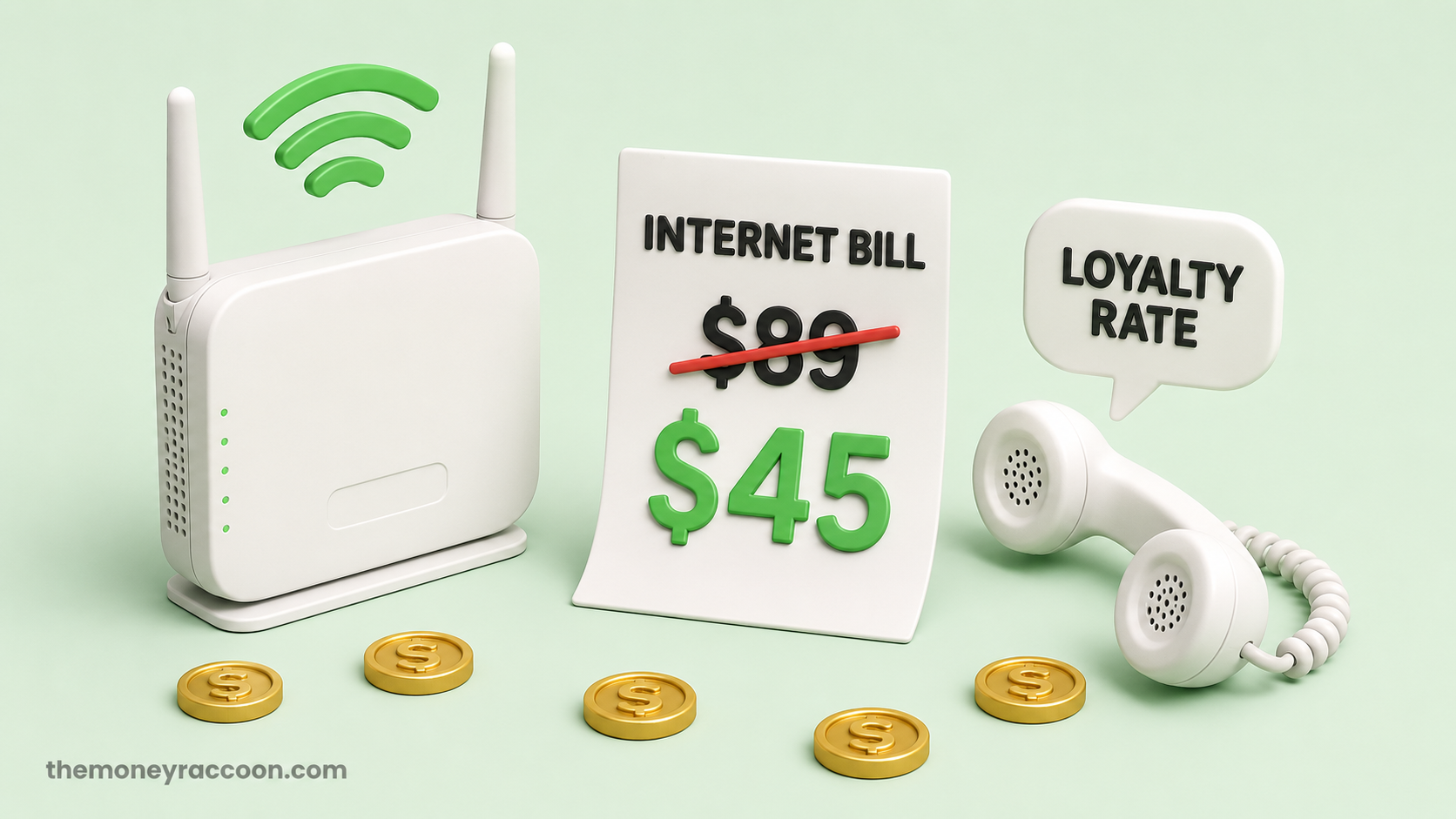
Figuring out how to lower your internet bill starts with one uncomfortable number: the average American household now pays about $81 a month for home internet — roughly $19 more than the advertised price they signed up for, once equipment fees, taxes and the quiet death of the promo rate do their work.
Same house. Same router blinking in the corner. Same Netflix buffering at 8pm. Just a bill that grew while nobody was watching.
The good news: internet is one of the most negotiable — and most replaceable — bills you have. Below are eight ways to shrink it, from the two-minute fixes (you might be renting a router you could own) to the retention-department phone call, with the exact script included. Most readers can claw back $20–40 a month. Let’s go get it.
Bottom line first: You can lower your internet bill by calling the retention department with a competitor’s price (savings: $15–40/mo), buying your own modem instead of renting ($10–15/mo), downgrading speed you don’t use, or switching to 5G home internet — which averages just $45/mo. Low-income households can also stack the FCC’s Lifeline discount with provider programs from $14.99/mo.
Why Your Bill Keeps Creeping Up
Internet pricing is designed around one bet: that you won’t pay attention. Three mechanisms do the creeping:
The promo cliff. That $39.99 you signed up for was a 12-month introductory rate. Month 13, it quietly becomes $69.99 — no call, no confetti. The industry counts on you not noticing the exact month it happens.
Equipment rental. The modem/router combo you’ve been renting for $15 a month costs about $120 to buy outright. Rent it for three years and you’ve paid $540 for a box worth a fraction of that.
Fee stacking. “Broadcast TV fees,” “network enhancement fees,” data-cap overages — a survey found the real bill runs about $19/month above the advertised price. None of those fees are set in stone, but they renew themselves every month you don’t ask.
The playbook below attacks all three.
What Providers Actually Charge in 2026
Before you negotiate, know the battlefield. The current going rates — the numbers you’ll quote on the phone:
| Provider | Cheapest Plan (new customer) | Typical Range | Type |
|---|---|---|---|
| T-Mobile Home Internet | from ~$35 (less bundled w/ phone) | $35–70 | 5G wireless |
| Verizon 5G Home | from ~$35 (less w/ phone plan) | $35–70 | 5G wireless |
| Xfinity | from ~$30 | $30–165 | Cable |
| Spectrum | from ~$30 | $30–125 | Cable |
| AT&T Fiber | from ~$35 | $35–90 | Fiber |
| National average (all-in) | — | ~$81/mo | — |
Two things to notice. First: 5G home internet averages just ~$45/month — the cheapest category on the market, and the disruptive threat every cable rep fears. Second: every “from” price above is a new-customer rate. Your mission is to get treated like a new customer without leaving — or to actually leave.
How to Lower Your Internet Bill: 8 Ways That Work
1. Make the retention call (the big one). Say “cancel my service” to reach retention, quote a competitor’s price from the table above, and ask for a loyalty rate. Stay polite, embrace the awkward silence, counter once. This single call is worth $15–40/month, and we wrote the full word-for-word script — plus scripts for six other bills — copy it before you dial.
2. Buy your own modem and router. If you see an “equipment fee” of $10–15 on your bill, you’re renting. A solid modem+router combo pays for itself in under a year and lasts five. Check your provider’s compatible-device list, buy, activate, return their box, and watch the fee vanish. This one requires zero negotiation skills — it’s just math.
3. Downgrade speed you don’t use. Providers love selling 500 Mbps to households that stream on two screens — which needs maybe 50. Run a speed test during your busiest evening; if your plan is 3–4x what you actually pull, drop a tier and save $15–30. (Rule of thumb: 100–300 Mbps covers a normal family with room to spare. Gamers and 4K-everything households, stay high.)
4. Switch to 5G home internet. T-Mobile and Verizon will mail you a plug-in box — no technician, no installation, no data caps, averaging ~$45/month, and cheaper still if they already carry your phone plan. Coverage is address-specific, so check yours first. Even if you don’t switch, a real 5G quote for your address is the sharpest knife you can bring to the retention call.
5. Harvest the new-customer promo. If retention won’t budge, actually switch — new-customer rates are real money, and win-back offers from your ex-provider often arrive within weeks. Household with two adults? When the promo dies, the account can close and reopen under the other name at the new-customer rate. Providers grumble; it’s allowed.
6. Audit the fee lines. Get your full bill PDF and read every line. Data cap overage? Many providers sell unlimited for less than two months of overage fees. “Broadcast TV fee” on a TV bundle you barely watch? Cutting the TV half of the bundle often saves more than the “bundle discount” was worth. Autopay + paperless discounts ($5–10) — make sure you’re actually getting them.
7. Check the low-income programs (post-ACP rules). The federal ACP died in 2024 and nothing replaced it — but these still exist in 2026: the FCC’s Lifeline ($9.25/mo discount, for SNAP/Medicaid/income-qualified households), Xfinity Internet Essentials ($14.99/mo), Spectrum Internet Assist ($17.99/mo) and AT&T Access (up to $30/mo). If anyone in your household gets SNAP, Medicaid or SSI, you likely qualify — and Lifeline stacks with provider programs.
8. Put it on the calendar. Whatever rate you win today has an expiration date — usually 12 months. Set a reminder for month 11 and make the call again. One recurring 20-minute ritual keeps the promo cliff from ever hitting you twice. That’s the entire long game of how to lower your internet bill: never let a promo expire unchallenged.
The 20-Minute Action Plan
If you only do three things after reading this:
- Today: check your bill for an equipment rental fee (#2) and missing autopay discounts (#6) — five minutes, no phone call
- This week: get a 5G home internet quote for your address (#4), then make the retention call armed with it (#1) — script here
- Month 11: calendar reminder → repeat
Realistic outcome: $20–40/month back, or $240–480 a year — for one afternoon of mild awkwardness.
FAQ: How to Lower Your Internet Bill
Can I negotiate my internet bill without threatening to cancel? Yes, but your odds drop. Regular support agents can fix fees and apply missing discounts; only the retention department holds the real loyalty rates, and saying “I’m thinking about canceling” is how you reach them. You don’t have to mean it — you just have to have a competitor’s price ready.
How much internet speed do I actually need? Streaming HD uses ~5 Mbps per screen; 4K about 25; video calls 3–5. A household of four doing all of it simultaneously fits comfortably in 100–300 Mbps. If you’re paying for 500+ Mbps “just in case,” that’s often $20/month of insurance you don’t need.
Is 5G home internet as good as cable? For most households, yes — and it’s the cheapest category on the market at ~$45/month average. Latency is slightly higher than cable/fiber (competitive gamers may notice), and speeds vary by address and network congestion. The try-before-you-commit is easy: both T-Mobile and Verizon offer trial windows with no installation.
What replaced the ACP discount? Nothing, federally — the Affordable Connectivity Program ended in June 2024 and no successor has been enacted. What’s left: the FCC’s Lifeline program ($9.25/month discount) plus provider programs like Xfinity Internet Essentials ($14.99), Spectrum Internet Assist ($17.99) and AT&T Access (up to $30). Lifeline can stack with provider programs.
Does switching internet providers hurt your credit score? No — signing up for internet service typically involves at most a soft credit check, which doesn’t affect your score. The one trap: unreturned equipment or an unpaid final bill can be sent to collections, and that hurts. Return the box, get a receipt, confirm the account shows $0.
References: BroadbandNow — Home Internet Cost 2026, Allconnect — The real cost of internet, BroadbandNow — Low-income internet guide, FCC — Affordable Connectivity Program, FCC — Lifeline

Personal finance writer, founder and editor of The Money Raccoon — 5 years in the industry and 1,000+ articles published in the finance niche. I turn complex money rules — credit scores, debt, banking and investing — into plain-English guides backed by primary sources and real numbers. Every guide here is fact-checked against the institutions that publish the data and updated when the numbers change.