
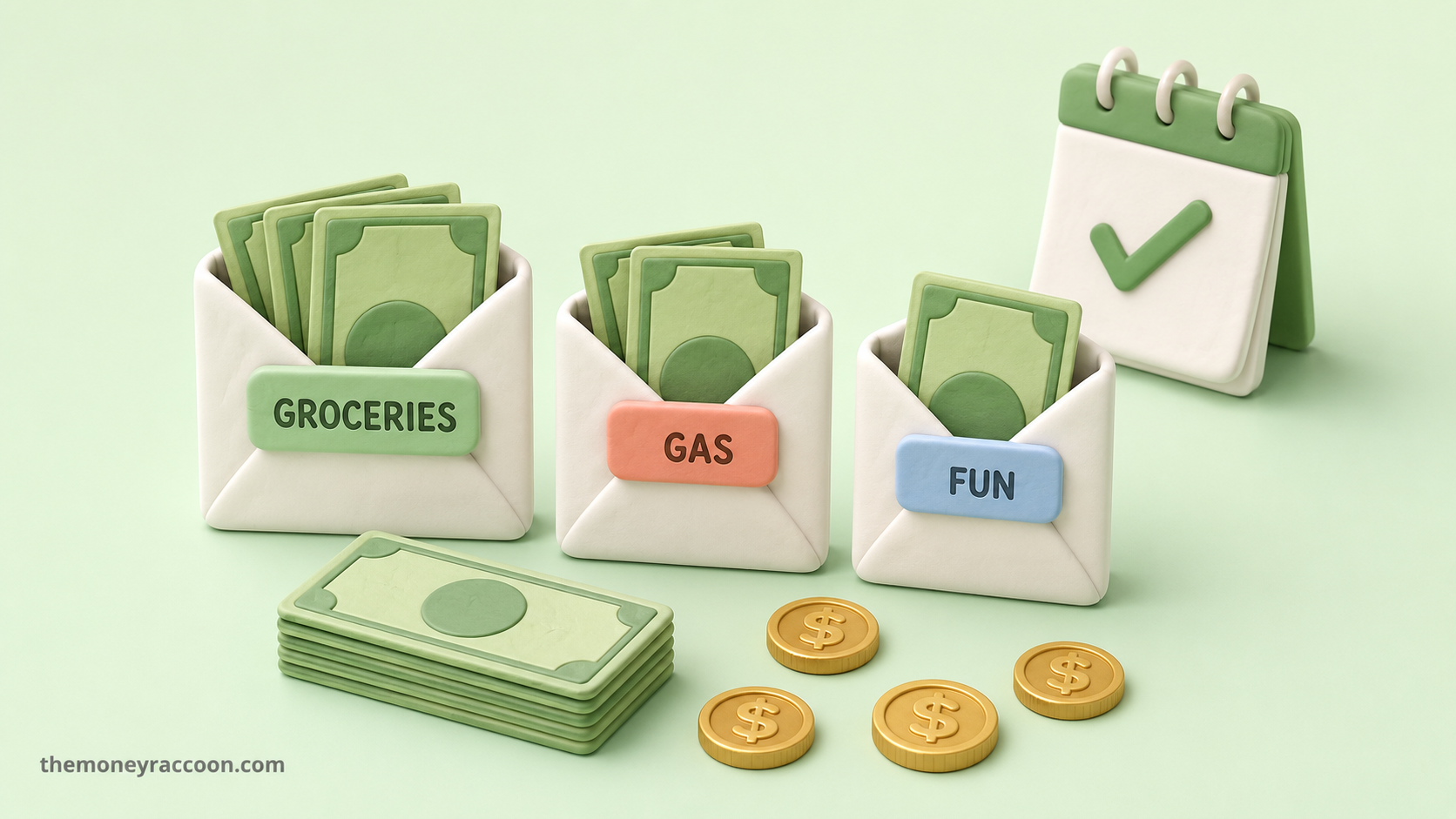
The cash envelope system is the oldest budgeting method still in active service — your great-grandmother probably ran her household on it — and somehow it keeps beating apps built by teams of engineers.
TikTok rebranded it as “cash stuffing” and made it a billion-view phenomenon, but the machine underneath is unchanged: physical envelopes, physical cash, and a rule so simple it fits on one line.
When the envelope is empty, the spending stops.
No overdraft. No “I’ll move some money over.” No end-of-month archaeology trying to figure out where $400 disappeared to. The envelope knows.
This guide covers the whole thing: why cash works on your brain in a way plastic can’t (there’s an MIT study), the exact steps to start this payday, the categories list that makes or breaks the system, and the digital version for people who’d rather not carry bills around.
The quick version: The cash envelope system is a budgeting method where you withdraw your monthly variable spending in cash and divide it into labeled envelopes — groceries, gas, eating out, fun money. Each envelope’s cash is that category’s entire budget; when it runs out, spending in that category ends until next payday. Fixed bills (rent, utilities) stay digital — envelopes only manage the money that leaks.
Why Cash Beats Plastic (Ask MIT)
This isn’t folk wisdom — it’s one of the most replicated findings in behavioral economics.
In the classic MIT experiment, researchers Prelec and Simester auctioned sold-out basketball tickets to two groups: one could pay only in cash, the other only by credit card. Identical tickets. Identical rules. The card group bid 64–113% more — up to double — for the same seats.
The mechanism is called the pain of paying. Handing over cash couples the loss to the purchase: you feel the money leave. A card (or worse, a saved card in an app) decouples them — the dopamine arrives now, the statement arrives in three weeks, and your brain’s spending brake never engages.
The cash envelope system is simply that brake, weaponized. Every purchase costs visible, countable bills from a finite stack — and a dozen small “do I really want this?” moments per week quietly add up to hundreds of dollars that stay home.
How to Start a Cash Envelope System in 6 Steps
Step 1: Split your spending into “fixed” and “variable”. Fixed = rent, utilities, insurance, subscriptions, debt payments — anything automatic. These stay in your bank account on autopay (cash would only complicate them). Variable = everything you decide in the moment: food, gas, fun. That’s envelope territory, and it’s where budgets actually die.
Step 2: Give every variable category a number. Look at your last 2–3 bank statements and total what you actually spent per category — not what you wish you spent. Set each envelope’s budget slightly below that reality (10–15% below is a challenge; 40% below is a fantasy that fails by day 12).
Step 3: Withdraw the total in cash on payday. If your variable categories add up to $700/month, that’s one ATM/bank withdrawal — ask for small denominations ($20s, $10s, $5s), which make partial spending and envelope math easy.
Step 4: Stuff the envelopes. Label one per category, fill each with its exact amount. This five-minute payday ritual — yes, the one in all the “cash stuffing” videos — is oddly satisfying and doubles as a monthly budget review you’ll actually do.
Step 5: Spend only from the envelope. Groceries come from the groceries envelope. Leave the cards at home for variable purchases. Tuck receipts back into the envelope if you like a paper trail.
Step 6: When it’s empty, it’s over. This is the entire system, and the only rule you cannot break. No topping up from other envelopes “just this once” — a transfer needs to be a deliberate decision, out loud, with a reason (see mistakes below).
Paycheck-to-paycheck? Run the system per paycheck instead of per month: half budgets, stuffed twice a month. Same machine, smaller cycles.
The Envelope Categories List (25+ That Actually Work)
Start with 5–7 envelopes maximum — the system’s biggest killer is launching with fifteen. The Core Five cover most leaks:
| Envelope | Typical Range (single) | Typical Range (family of 4) |
|---|---|---|
| Groceries | $250–400 | $700–1,100 |
| Gas / transport | $100–200 | $200–350 |
| Eating out | $75–150 | $150–300 |
| Fun money | $50–100 | $100–200 per adult |
| Miscellaneous | $50–100 | $100–150 |
The full menu — add only what matches a real leak in YOUR statements:
- Daily life: groceries · gas · eating out · coffee/snacks · rideshare · parking/tolls
- Personal: fun money (one per adult!) · clothing · haircuts/beauty · hobbies · books/games
- Family: kids’ activities · school stuff · babysitting · pet food/vet · allowances
- Social: gifts · date night · nights out · hosting/entertaining
- Sinking funds (slow-fill envelopes): car maintenance · home repairs · Christmas/holidays · birthdays · vacation · annual fees · medical copays
Sinking funds are the pro move: $25/month into a “car maintenance” envelope means the $300 brake job eight months from now is already paid — that’s an emergency that never gets to happen. (They stack beautifully with a starter emergency fund if you’re also working through a debt payoff plan.)
Don’t Want to Carry Cash? The Digital Version
The psychology is strongest with physical bills, but the structure survives digitization — and for online spending it has to:
Envelope apps. Goodbudget is the classic (free tier: 10 digital envelopes, syncs between spouses), and apps like EveryDollar and YNAB run on the same give-every-dollar-a-job logic. You “fill” virtual envelopes and log spending against them.
Bank sub-accounts. Several online banks let you split your balance into named buckets — same idea, built into the account. One debit card + a rule about which bucket a purchase belongs to.
The hybrid (our recommendation). Cash envelopes for your 2–3 worst leak categories — for most people that’s groceries, eating out and fun — digital buckets for the rest. You get the MIT effect where it pays the most rent, without carrying your whole budget in a purse.
Two safety notes for the cash portion: keep only the current month at home (not your savings — cash in a drawer earns nothing and isn’t insured), and carry only the envelope you’re using today. Lost cash has no fraud department.
The 5 Mistakes That Kill the System
1. Too many envelopes. Fifteen categories = a part-time accounting job. Start with five; add one per month only if a leak demands it.
2. No fun money envelope. A budget with zero joy is a diet of only celery — it ends in a binge. The fun envelope isn’t a weakness in the system; it’s the pressure valve that keeps the rest sealed.
3. Silent envelope-to-envelope loans. “Borrowing” $20 from gas for takeout, unspoken, is how the system dissolves. The grown-up version: transfers are allowed but must be explicit — say it, move the bills, accept that gas month just got smaller.
4. Putting fixed bills in envelopes. Rent doesn’t need psychology — it needs autopay. Envelope only what you decide in the moment. (Want the fixed bills smaller too? That’s a phone call, not an envelope — and your internet bill has its own playbook.)
5. Quitting after one blown envelope. Emptying the eating-out envelope by the 14th isn’t failure — it’s data. It means that number was wrong, or that category is your weak spot. Adjust next month’s stuffing and keep going; the system gets accurate around month three.
The cash envelope system works because it doesn’t ask for willpower at the end of the month — it front-loads one honest decision on payday and lets physics handle the rest. Empty envelope, closed wallet. Try it for ninety days with five envelopes: that’s long enough for the numbers to get honest and the habit to stop feeling like effort. Most people who stick past month one report the same strange discovery — spending less starts to feel like winning, not losing.
FAQ: Cash Envelope System
Does the cash envelope system really work? For variable spending, yes — and the evidence is strong. The MIT pain-of-paying research showed people will pay up to twice as much for the same item on a card versus cash. The envelope simply forces every purchase through that cash filter, plus a hard ceiling per category. Where it fails is when people envelope fixed bills or launch with too many categories.
Is cash stuffing the same as the cash envelope system? Same system, new name — “cash stuffing” is the TikTok-era rebrand, focused on the payday ritual of filling (stuffing) the envelopes. The viral videos usually add aesthetic binders and colored envelopes; the mechanics underneath are identical.
How do I use the envelope system for online shopping? Three options: use a digital envelope app (Goodbudget, EveryDollar) for online-heavy categories; keep an “online” envelope and physically move cash out of it into a “deposit” envelope when you buy something, then transfer that back to your bank; or simply make online-prone categories digital buckets and keep cash for in-person leaks like groceries and eating out.
How many envelopes should I have? Five to seven to start: groceries, gas, eating out, fun money, miscellaneous — plus maybe one or two sinking funds (car, gifts). More than ten and the admin cost starts killing the habit. Add categories only when your statements show a real leak that needs its own wall.
What do I do with leftover envelope money at the end of the month? Pick a rule and keep it: roll it over (great for sinking funds), sweep it to savings or extra debt payment (satisfying “payday bonus”), or split it — roll half, sweep half. What matters is that leftover cash gets a job instead of quietly upgrading next month’s lifestyle.
Research and references: MIT Sloan — Credit cards “step on the gas” for spending (Prelec & Simester), MIT Sloan — Credit cards increase the pleasure of purchasing

Personal finance writer, founder and editor of The Money Raccoon — 5 years in the industry and 1,000+ articles published in the finance niche. I turn complex money rules — credit scores, debt, banking and investing — into plain-English guides backed by primary sources and real numbers. Every guide here is fact-checked against the institutions that publish the data and updated when the numbers change.