
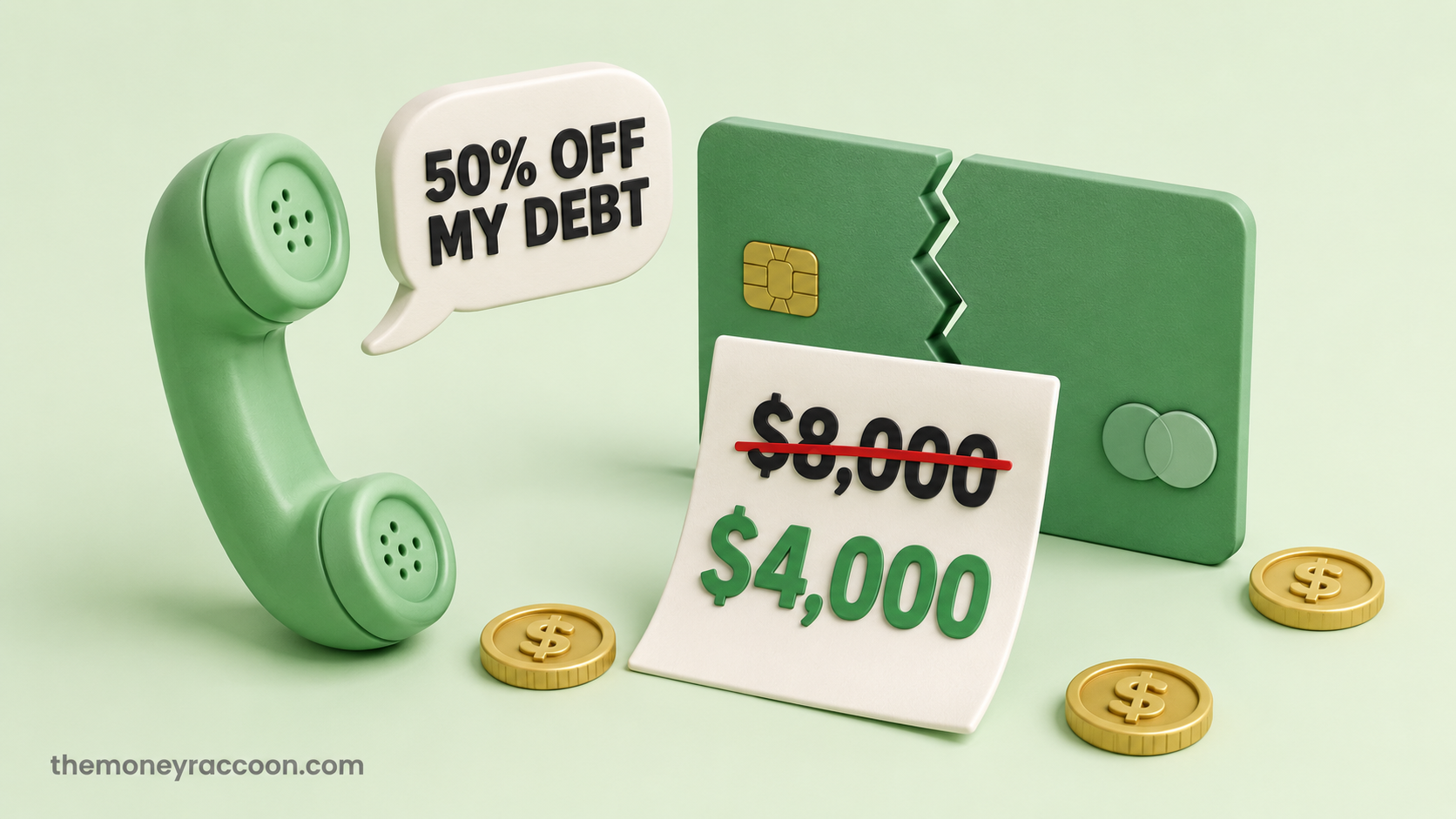
Nobody teaches you how to negotiate credit card debt — and the silence is profitable. Debt settlement companies charge thousands to make phone calls you could make yourself. Card issuers quietly run hardship programs they don’t advertise. And millions of people keep minimum-paying balances at 20%+ interest because they don’t know the magic words exist.
Here’s the part the industry doesn’t say out loud: banks negotiate all the time. A cardholder who calls before things fall apart is worth more to them than a charged-off account sold to collectors for pennies. Your leverage is real — you just need to know which program to ask for, in what order, and what to say when the agent picks up.
That’s this guide: the four negotiation lanes, the exact scripts for each, the traps that cost people thousands, and what happens to your credit afterward. All of it doable yourself, for free.
The gist: You can negotiate credit card debt directly with your issuer through four programs: a hardship plan (lower APR and payments, short-term), a workout agreement (long-term reduced terms), a lump-sum settlement (typically 40–60% of the balance, usually after serious delinquency), or a debt management plan through a nonprofit credit counselor. Call the number on your card, ask for the hardship department, and get every agreement in writing.
Before You Call: Know Your Position
Five minutes of prep changes the entire conversation.
Know which fight this is. Still paying the original card issuer? This article is your playbook. Already charged off and sold to a collection agency? Different arena with different rules — that playbook is here, and it’s arguably more favorable to you.
Know your real number. Before any call, calculate what you can actually pay monthly — honestly, after essentials. Offering a number you can’t sustain torpedoes the deal and your credibility. If the budget math is grim, one round of bill negotiations often frees $50–150/month to work with.
Know the trade-offs. Negotiation isn’t free money: hardship plans may freeze your card; settled debt is usually reported as “settled for less than owed” (a credit scar that fades, but a scar); and forgiven amounts over $600 typically generate a 1099-C — the IRS treats canceled debt as taxable income. Eyes open beats surprises.
Know your leverage moment. Uncomfortable truth: issuers settle deepest when accounts are 90–180 days delinquent, because charge-off looms. If you’re current and just struggling, lead with hardship programs — settlement talk comes later, if ever.
How to Negotiate Credit Card Debt: The 4 Lanes (With Scripts)
| Lane | Best When | Typical Outcome | Credit Impact |
|---|---|---|---|
| 1. Hardship plan | Struggling but current | APR cut, waived fees, 6–12 mo | Minimal |
| 2. Workout agreement | Long-term income drop | Permanently reduced APR/payment | Card usually closed |
| 3. Lump-sum settlement | 90+ days behind, cash available | Pay 40–60%, rest forgiven | “Settled” mark, real dent |
| 4. Debt management plan | Multiple cards, need structure | ~8% APR average via nonprofit | Mild; cards closed |
Script 1: The Hardship Plan (start here if you’re current)
Call the number on your card, say “financial hardship” to the menu, then:
“Hi, I’ve been a customer since [year] and I’ve always tried to pay on time. I’m going through a financial hardship because of [job loss / medical bills / divorce — one sentence, honest]. I want to keep paying, but I can’t sustain the current payments. Does your hardship program have options to lower my interest rate or monthly payment while I get back on my feet?”
Most major issuers have exactly this program sitting unadvertised. Typical wins: APR slashed (sometimes to 0% temporarily), fees waived, payments reduced for 6–12 months. It’s the lowest-cost, lowest-damage lane — always exhaust it first.
Script 2: The Workout Agreement (when hardship isn’t enough)
“Thank you — I appreciate the hardship option, but my situation is longer-term. I’d like to discuss a workout arrangement: a permanently lower rate and a payment plan I can actually sustain, so this account never has to go to charge-off. What can we structure together?”
The phrase “so this account never has to go to charge-off” does quiet work: it reminds them of their downside. Expect a closed card in exchange for genuinely sustainable terms — a fair trade when the alternative is drowning.
Script 3: The Lump-Sum Settlement (the 40–60% conversation)
Only with real cash in hand, and realistically once you’re seriously delinquent:
“I want to resolve this account, but I can’t pay the full balance — my situation is [one sentence]. I have access to [amount — start around 35–40% of the balance] as a one-time payment if we can agree to settle the account in full. Can you make that work, or connect me with someone who can?”
They’ll counter. Somewhere between 40–60% is the common landing zone. Two iron rules: never pay a cent before the agreement is in writing stating the payment settles the account in full, and never give a collector direct access to your bank account — pay by cashier’s check or one-time payment. The CFPB’s guidance on negotiating settlements backs every word of this.
Script 4: The Nonprofit Backstop (when it’s several cards at once)
If you’re juggling multiple cards and the calls feel overwhelming, a debt management plan through a nonprofit agency affiliated with the NFCC consolidates everything into one payment at drastically reduced interest — the nonprofit negotiates with every issuer for you, for a small monthly fee. Your script is one sentence to the counselor: “I’d like a free budget review and to see if a DMP makes sense for me.” This is the legitimate version of what debt settlement companies charge thousands to imitate badly.
The 4 Mistakes That Cost People Thousands
Paying a settlement company first. They charge 15–25% of your debt, tell you to stop paying (wrecking your credit deliberately), and make the same calls you just read scripts for. The CFPB warns about this industry for a reason. Nonprofit counseling (Script 4) costs a fraction and doesn’t torch your score on purpose.
Accepting verbal deals. The friendly agent’s promise evaporates when the next agent pulls up your account. Every agreement — hardship terms, settlement amount, “account will be reported as X” — exists only when it’s in writing, before money moves.
Draining protected money to settle. Retirement accounts are generally protected from creditors; emptying a 401(k) to settle a card is often trading protected money for unprotected debt — plus taxes and penalties. Run the math (or the free math on your whole debt picture) before touching it.
Going silent. Ignoring the situation is the only strategy with a 100% failure rate: late fees stack, the APR climbs, charge-off lands at 180 days, then collections, then possibly a lawsuit. One awkward phone call today beats all of it.
After the Deal: Protect It and Rebuild
Get the final agreement letter and keep it forever — settled accounts have a way of resurrecting as “zombie debt” years later, and that letter is your silver bullet. Watch January’s mail for a 1099-C if debt was forgiven, and budget for the tax. Confirm on your credit reports that the account reports exactly as agreed (dispute it if not). Then start the rebuild: on-time payments on everything remaining, utilization down, and the full 100-point recovery playbook — most people who settle see their score begin recovering within months, because the crushing utilization disappears.
FAQ: How to Negotiate Credit Card Debt
Can I negotiate credit card debt myself without a company?
Yes — everything settlement companies do is a phone call you can make free. Issuers have hardship departments precisely for direct negotiation, and nonprofit credit counselors (NFCC-affiliated) handle the complex multi-card cases for a small fee. The scripts above are the entire toolkit.
How much will credit card companies settle for?
Lump-sum settlements typically land at 40–60% of the balance, depending on how delinquent the account is and the issuer’s policies. Accounts near charge-off settle deepest. Current accounts rarely get settlement offers at all — but qualify for hardship plans instead.
Does negotiating credit card debt hurt your credit score?
Depends on the lane. Hardship plans done while current: minimal impact. Settlements: the “settled for less than full amount” notation is a real negative that fades over time — but it’s consistently less damaging than a charge-off followed by collections, which is the alternative path.
Will negotiating stop the card from being usable?
Usually the negotiated card gets frozen or closed — issuers rarely reduce your rate and keep the credit line open. Plan for it: keep one unaffected card active for emergencies and utilization history before you start negotiating others.
Do I have to pay taxes on forgiven credit card debt?
Generally yes: forgiven debt over $600 triggers a 1099-C, and the IRS counts it as income. Exception: if you were insolvent (debts exceeded assets) when the debt was forgiven, IRS Form 982 may exclude some or all of it — worth a tax professional’s hour if the forgiven amount is large.
Don’t walk into the call empty-handed. Grab the free Debt Negotiation Prep Sheet — your numbers organized, the right script picked for your situation, and the in-writing checklist to protect any deal. Drop your email below and it’s yours.
Where these numbers come from: CFPB — What is debt settlement?, CFPB — Negotiating a settlement with a debt collector, NFCC — Nonprofit credit counseling, LendingTree — Average credit card APR

Personal finance writer, founder and editor of The Money Raccoon — 5 years in the industry and 1,000+ articles published in the finance niche. I turn complex money rules — credit scores, debt, banking and investing — into plain-English guides backed by primary sources and real numbers. Every guide here is fact-checked against the institutions that publish the data and updated when the numbers change.