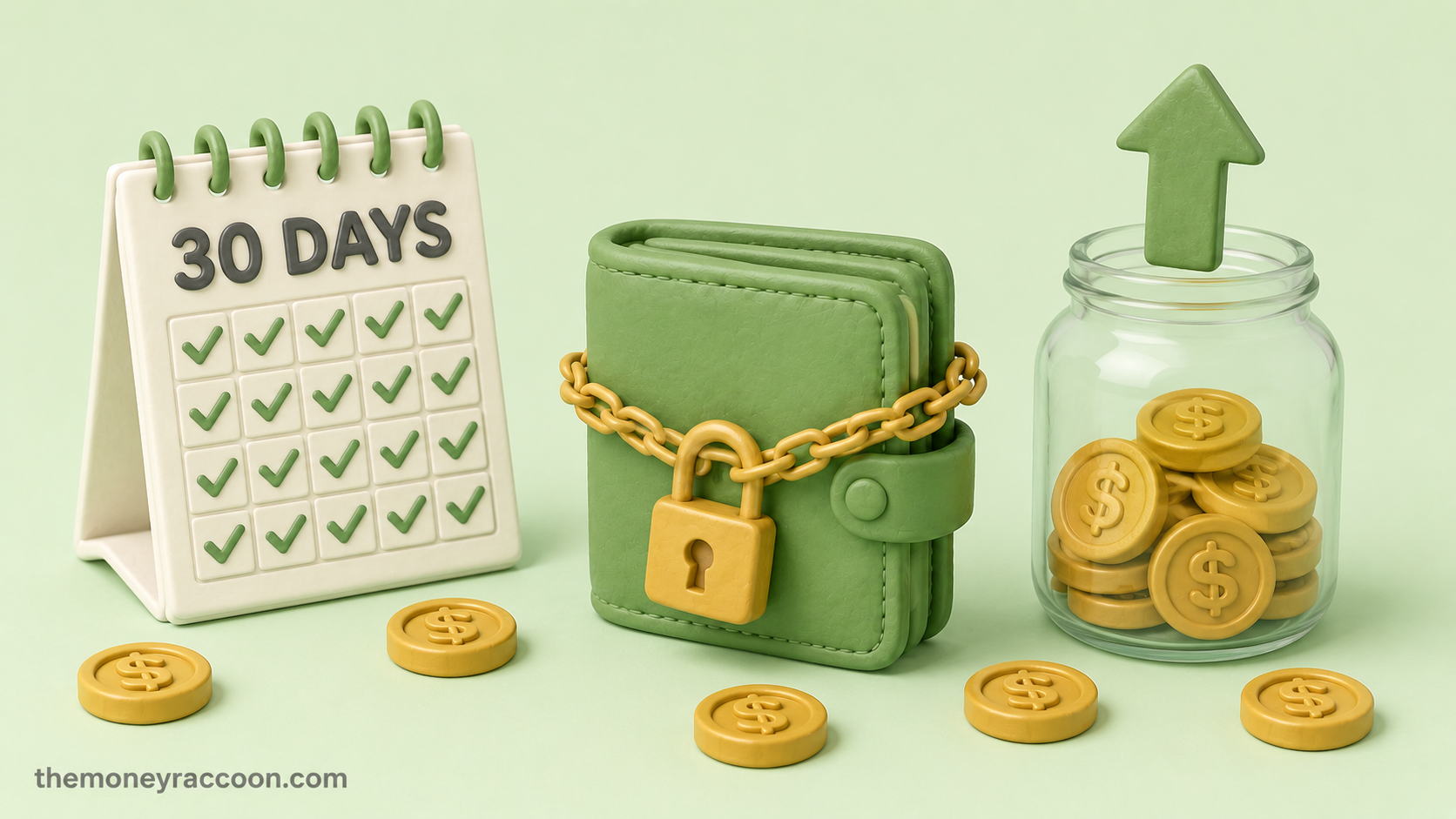
A no spend challenge rules is exactly what it sounds like: for 30 days, you stop buying everything that isn’t essential. No takeout, no impulse Amazon, no “it was on sale.” Bills get paid, groceries get bought — everything else goes on pause.
People come for the savings (typically $300–800 in a month, depending on habits). They stay for the weirder, more valuable prize: 30 days of watching your own spending impulses in real time. Most people finish knowing exactly which three habits quietly drain their money — knowledge that keeps paying long after the challenge ends.
But the challenge lives or dies on one thing: clear rules, set before day one. Vague rules turn into daily negotiations with yourself, and you lose those. So here’s the complete rulebook — what’s allowed, what’s banned, the gray areas decided in advance, the four hardest days, and what to do with the money you don’t spend.
Bottom line first: The no spend challenge rules: for 30 days, buy only true essentials — housing, utilities, groceries, transport, medications — and cut everything optional: dining out, delivery, entertainment purchases, clothes, hobbies, impulse buys. Decide your personal gray areas (gifts, planned events) before day one, track every “almost bought” moment, and give the saved money a job (debt or savings) on day 30.
The Official Rules
| ✅ Allowed (essentials) | ❌ Banned (everything else) |
|---|---|
| Rent/mortgage, utilities, insurance | Restaurants, takeout, delivery, coffee out |
| Groceries (list-based, no snack hauls) | Clothes, shoes, accessories |
| Transport (gas, transit, required repairs) | Impulse online shopping (“it’s only $12”) |
| Medications & health needs | Entertainment purchases, in-app buys, new subscriptions |
| Debt payments & existing subscriptions you keep | Hobby gear, gadgets, home décor |
| Pet & child essentials | “Sales” and “deals” (a discount on unnecessary = unnecessary) |
The three meta-rules that make it work:
1. Write your gray-area verdicts before day one. A friend’s birthday dinner mid-month? A gift you already committed to? Decide now, in writing. Rules invented mid-challenge always bend toward spending.
2. Track the almosts. Keep a note on your phone: every time you nearly buy something, log it and the price. This list becomes the most valuable document of the month — it’s your personal leak map.
3. A slip doesn’t end the challenge. Bought something banned on day 9? Log it, learn from it, keep going. The all-or-nothing mindset is how challenges die on day 10; the goal is 30 days of awareness, not perfection.
No Spend Challenge Rules in Practice: The 30-Day Journey
Knowing the rules is half; knowing what the month feels like is the other half. The four predictable hard days:
Days 1–3: The novelty high. Easy mode. You feel virtuous, the wallet stays shut, motivation is free. Enjoy it — and use the energy to prep: plan cheap meals for the month and unsubscribe from every store email tempting you.
Days 5–9: The habit withdrawal. Your autopilot spending — the coffee run, the lunch order, the scroll-and-buy — starts screaming. This is where the “almosts” list grows fastest, and where most quitters quit. Survival move: replace the ritual, not just the purchase (make the coffee, walk the same break, keep the pleasure minus the receipt).
Days 12–18: The social test. Invitations happen. Use the pre-written gray-area rules: suggest the free version (walk, potluck, game night), use your pre-approved exception if you set one, or say the sentence that surprises people with how well it lands: “I’m doing a no-spend month — can we do something free?”
Days 25–30: The finish-line trap. The sneaky urge to “reward yourself” early, or to build a mental shopping list for day 31. Both erase the win. The endgame move is Bloco 5.
Day 30: Give the Money a Job (or the Month Was Theater)
The challenge saves most people a few hundred dollars — but only on paper. Money you “didn’t spend” quietly reabsorbs into your checking account and vanishes within weeks unless you move it, deliberately, on day 30:
Add up the real number. Compare this month’s spending to a normal month (your “almosts” list + bank statement makes this easy). That’s your challenge harvest.
Then aim it at one target: high-interest debt, where it works hardest, or a high-yield savings account where it keeps growing instead of earning nothing. Transfer it the same day you calculate it — ceremony matters.
And keep the two best habits. Most finishers keep 2–3 discoveries permanently: the coffee they now make, the delivery app they deleted, the 24-hour rule before any purchase over $30. That’s the compounding prize — pair it with the envelope system and the no-spend month becomes a lower-spend life.
Make It Yours: Variations That Also Work
- The No-Spend Weekend — the gateway drug: Friday night to Sunday, zero optional spending. Great first rep.
- The Category Freeze — 30 days off just your worst category (delivery apps, clothes, Amazon). Less dramatic, very sustainable.
- The Partner Challenge — do it as a couple or with a friend: shared rules, shared “almosts” list, someone to text instead of buying. Accountability roughly doubles finish rates.
- January or October — the two classic months: post-holiday recovery, or pre-holiday war chest. Any month works; those two have momentum built in.
FAQ: No Spend Challenge Rules
- What are the basic rules of a no-spend challenge? Buy only essentials (housing, utilities, groceries, transport, medications, existing obligations) for a set period — usually 30 days — and pause all optional spending: dining out, delivery, clothes, entertainment purchases, impulse buys. Decide gray areas in advance and track every temptation.
- What can you buy during a no-spend challenge? Essentials only: bills, list-based groceries, gas or transit, medications, pet and child necessities, and debt payments. The test for anything else: “would my life or obligations break without this purchase this month?” If not, it waits.
- How much money can you save in a no-spend month? Typically $300–800 for one person, depending on how much optional spending you normally do — heavy takeout-and-Amazon habits save the most. The bigger payoff is the leak map: knowing exactly which 2–3 habits drain you, worth thousands per year if you keep them trimmed.
- What if I mess up during the challenge? Log the slip, note what triggered it, and continue — a failed day is data, not defeat. The challenge’s real product is 30 days of spending awareness; quitting over one purchase throws away the remaining days of insight.
- Does a no-spend challenge actually work long-term? As a one-off stunt, no — spending rebounds. As a reset that reveals your personal leaks and breaks autopilot habits, yes: most successful finishers permanently keep 2–3 changes, and pairing the reset with a system (envelopes, a 24-hour purchase rule) is what converts a good month into a better year.
The challenge framework, rules and savings ranges are original to The Money Raccoon, based on standard no-spend methodology. Behavior insight on habit substitution: APA — Harnessing habits.

Personal finance writer, founder and editor of The Money Raccoon — 5 years in the industry and 1,000+ articles published in the finance niche. I turn complex money rules — credit scores, debt, banking and investing — into plain-English guides backed by primary sources and real numbers. Every guide here is fact-checked against the institutions that publish the data and updated when the numbers change.