Savings account interest rates are doing something unusual right now: they’re barely moving at the top of the market, while the money sitting in most Americans’ accounts earns almost nothing at all.
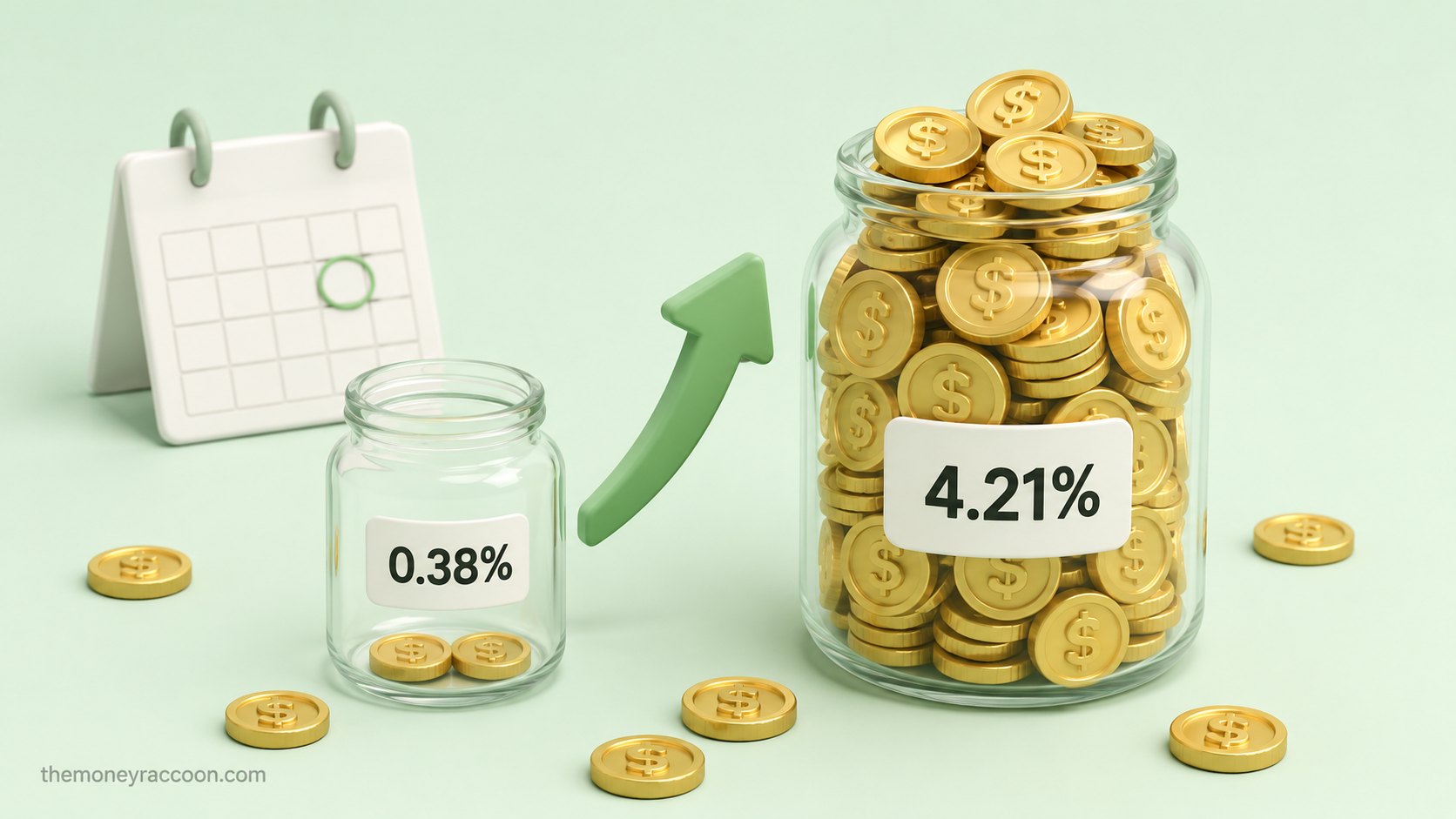
The numbers say it plainly. The best high-yield savings accounts currently pay up to 4.21% APY — while the national average sits at 0.38%. That’s not a small difference in fine print. On $20,000, it’s the gap between earning about $76 a year and earning roughly $842.
Behind the stability is the Fed. On July 29, 2026 the Federal Reserve held the federal funds rate at 3.50%–3.75% — the fifth straight decision without a change — and the next announcement lands on September 16, 2026. Since deposit rates follow that benchmark, the pause is exactly why today’s window is worth using rather than waiting out.
Here’s where rates stand, what the Fed’s pause actually means for your savings, and the five moves worth making before the September meeting.
In one paragraph: The best savings account interest rates currently reach about 4.21% APY, versus a national average of 0.38%. The Federal Reserve has held its benchmark at 3.50%–3.75% through five straight meetings, with the next decision on September 16, 2026 — so top savings rates have been steady rather than falling. The single highest-value move for most people isn’t timing the Fed, it’s switching from an average-paying account to a top-paying one, which multiplies interest earned by roughly ten times.
Where Savings Account Interest Rates Stand Right Now
| Type of Account | Typical APY | What $20,000 Earns in a Year |
|---|---|---|
| Top high-yield savings | 4.15% – 4.21% | about $830 – $842 |
| Mid-tier online banks | 3.50% – 4.00% | about $700 – $800 |
| National average | 0.38% | about $76 |
| Big-bank basic savings | 0.01% – 0.10% | about $2 – $20 |
APYs as of August 2026 and variable — they change without notice.
Look at the top row against the bottom two. That distance is not a reward for expertise or a minimum balance you don’t have — it’s simply the difference between banks that compete for deposits and banks that count on you never checking.
Most large traditional banks pay near the bottom of this table because they don’t have to pay more: the average customer doesn’t move. Online banks and a handful of credit unions pay near the top because deposits are how they fund lending, and rate is the only lever they have to attract you. The full breakdown of what different balances earn is here.
What the Fed Actually Does to Savings Account Interest Rates
The chain is short and worth understanding, because it tells you when to act:
The Fed sets the federal funds rate — currently 3.50%–3.75%, unchanged since early 2026. Banks price deposits off that benchmark. When the Fed cuts, savings APYs drop within weeks, often without any notice beyond a line in your statement. When the Fed raises, competitive banks lift rates to win deposits.
What the pause means for you: five consecutive holds have kept top savings rates unusually stable near 4.2%. That’s a stable window, not a shrinking one — but it’s also not permanent. Fed officials’ own projections point to a median federal funds rate near 3.1% by March 2027, which is the direction of travel that matters: down, gradually, from here.
Two practical consequences. First, savings APYs are variable by design — the 4.21% you open today can be 3.90% next quarter without your consent, and that’s normal. Second, that variability is precisely why locking part of your cash into a fixed-rate CD becomes attractive when cuts are on the horizon, while keeping your emergency fund liquid in savings.
The mistake to avoid: waiting for a “better moment” to switch banks. Someone earning 0.38% while debating the Fed’s next move is losing far more to inaction than any rate decision will cost them.
5 Moves to Make Before September 16
1. Move your savings to a top-paying account. This is the whole article in one sentence. Ten minutes of setup, roughly ten times the interest, zero risk — the accounts at the top of the table are FDIC insured exactly like the one you’re leaving. Opening one online with no deposit requirement takes about 10 minutes.
2. Collect a bonus while you’re at it. If you’re opening an account anyway, open one that pays you to do it — bank bonuses currently run $100 to $400 for meeting simple direct-deposit requirements. The current offers are tracked here and updated monthly. Doing this and step 1 together is the highest-return hour in personal finance.
3. Split emergency money from goal money. Rate shopping matters less than structure. Emergency savings stay liquid; money with a date attached can go somewhere less accessible and better paying. The 4-Account System lays out exactly where each dollar lives.
4. Consider locking part of your cash at a fixed rate. Savings APYs float; CD rates don’t. With Fed projections pointing lower into 2027, fixing a portion of your cash at today’s rates protects it from future cuts — while your emergency fund stays liquid in savings. Never lock money you might need before the term ends.
5. Set a calendar reminder for September 16. Not to panic-trade — to check. If the Fed cuts, your savings APY will drift down over the following weeks and it’ll be worth comparing again. If it holds, nothing to do. Five minutes, eight times a year, protects hundreds of dollars in interest.
(Educational content, not financial advice. APYs are variable and change without notice.)
The Fine Print That Eats Your Rate
Three traps turn an advertised APY into a disappointing statement:
Teaser rates with conditions. Some headline APYs apply only up to a balance cap, or require direct deposit, a minimum number of debit transactions, or a paired checking account. Read what the rate requires before you move money — an unmet condition can drop you to a fraction of the advertised number.
Rate drift after the honeymoon. Banks that lead the rankings sometimes let their rate slide once deposits arrive, betting you won’t notice. This is why the September checkpoint in step 5 exists: rate leadership rotates, and a two-minute comparison a few times a year keeps you near the top.
Monthly fees quietly canceling your interest. A $5 monthly maintenance fee is $60 a year — most of what an average $20,000 balance earns at the national average rate. The top accounts charge $0 and require $0 minimum; there is no reason to accept a fee on savings.
One thing that is not a trap: FDIC insurance is identical at online banks and big-name branches — $250,000 per depositor, per bank, per ownership category. The higher rate is not compensation for higher risk; it’s compensation for not having branches.
FAQ: Savings Account Interest Rates
What is a good savings account interest rate in 2026?
Anything at or above roughly 4.00% APY is competitive right now, with the best accounts reaching about 4.21%. The national average is 0.38%, and many big-bank savings accounts pay 0.01%–0.10% — so “good” and “typical” are very far apart. If your account pays under 3.5%, you’re leaving real money behind.
Why is my savings account interest rate so low?
Because large traditional banks don’t need to compete for your deposits — they rely on customers not moving. Online banks and credit unions pay near the top because deposits fund their lending and rate is their main way to attract them. Same FDIC insurance, very different payout.
Will savings account interest rates go down in 2026?
Top rates have been stable through five straight Fed holds, with the benchmark at 3.50%–3.75% and the next decision on September 16, 2026. Fed projections point to a median federal funds rate near 3.1% by March 2027, so the medium-term direction is gradually lower — which argues for capturing today’s rates rather than waiting.
Is it worth switching banks for a higher savings rate?
Almost always. On $20,000, moving from the national average to a top rate is roughly $76 versus $842 a year — for about ten minutes of setup and no added risk, since both are FDIC insured. Add a bank bonus for opening the account and the first-year return climbs further.
How often do savings account interest rates change?
Whenever the bank decides — savings APYs are variable and can change without notice, though they mostly move in response to Federal Reserve decisions, which happen eight times a year. Checking your rate a few times a year, around Fed meetings, is enough to stay near the top.
Where these numbers come from: NerdWallet — Best high-yield savings accounts, August 2026, CNBC Select — Best high-yield savings accounts, Yahoo Finance — Best high-yield savings rates today, Experian — CD and rate forecast. APYs as of August 2026 and subject to change. Educational content, not financial advice. Last updated: August 2026.

Personal finance writer, founder and editor of The Money Raccoon — 5 years in the industry and 1,000+ articles published in the finance niche. I turn complex money rules — credit scores, debt, banking and investing — into plain-English guides backed by primary sources and real numbers. Every guide here is fact-checked against the institutions that publish the data and updated when the numbers change.