
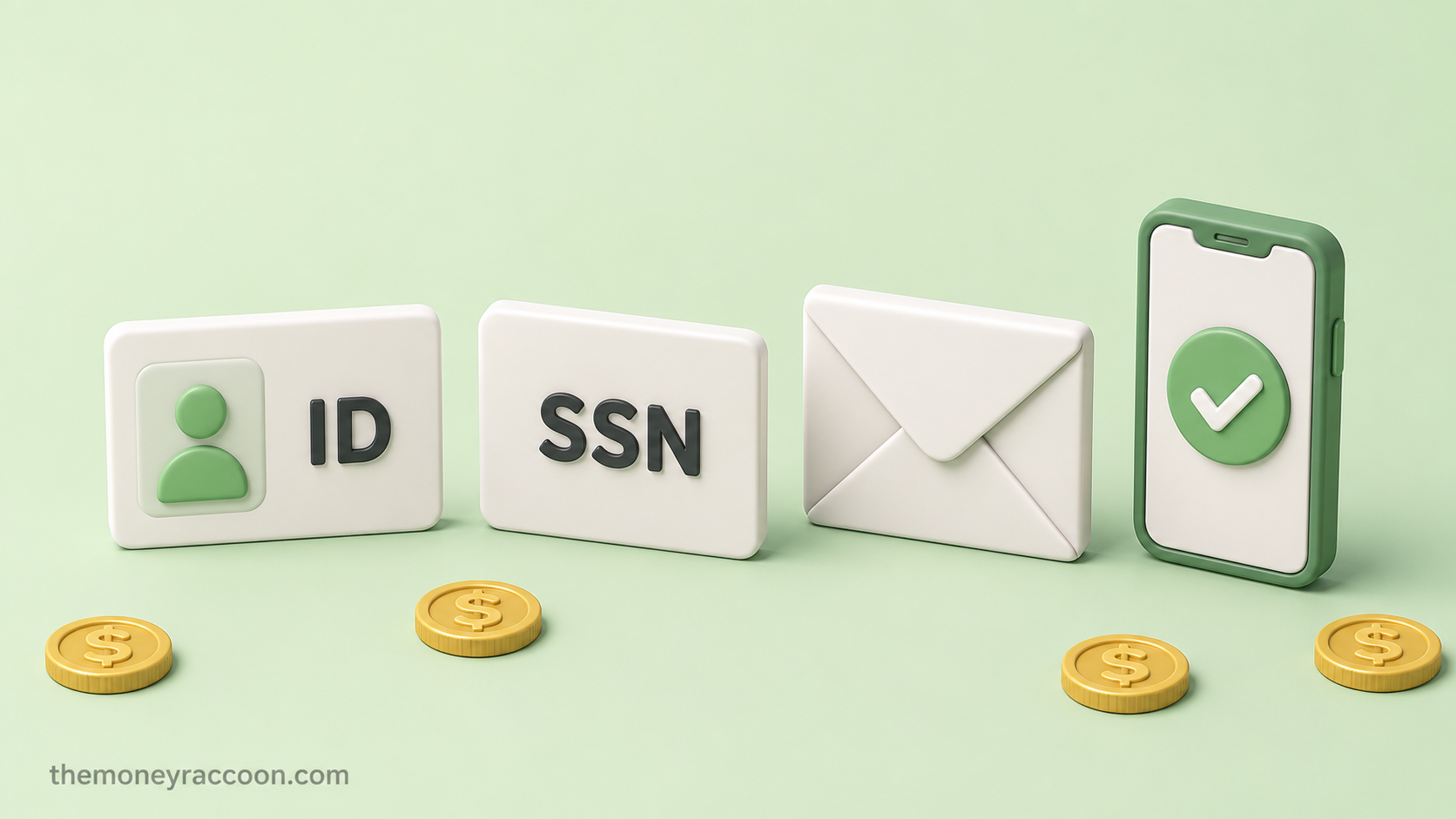
What do you need to open a bank account? Less than you probably think — and knowing the exact list beforehand turns a nervous errand into a ten-minute formality, whether you’re doing it online in your pajamas or walking into a branch.
The core list is short: a government ID, your Social Security number, an address, and sometimes a small opening deposit. That’s it for most people. But the details matter at the edges — students, teens, new immigrants, and anyone who’s been turned down before all have slightly different lists — so this checklist covers every situation, plus what actually happens after you hand it over.
Bookmark it, gather the four things, and you’re done before your coffee gets cold.
The short answer: To open a bank account you need four things: (1) a government-issued photo ID (driver’s license, state ID, or passport), (2) your Social Security number or ITIN, (3) proof of address (a piece of mail or a bill), and (4) an opening deposit if the bank requires one — though many online banks require $0. You must also be 18+ (minors open joint accounts with an adult).
The Complete Checklist to Open a Bank Account
| What You Need | Accepted Forms | Notes |
|---|---|---|
| Photo ID | Driver’s license, state ID, passport, military ID | Must be current and unexpired |
| Social Security number | SSN card, or just the number memorized | ITIN works at many banks if you don’t have an SSN |
| Proof of address | Utility bill, lease, bank statement, official mail | Usually needs your name + current address |
| Opening deposit | Cash, card, or transfer | $0 at many online banks; $25–100 at some traditional ones |
| Age 18+ | — | Under 18 = joint/custodial account with a parent or guardian |
| Contact info | Email + phone number | For account verification and alerts |
For most adults, that’s the entire list — and online, you’ll type most of it rather than scan it. The full 10-minute online walkthrough is here.
What Do You Need to Open a Bank Account in Special Situations?
The core list bends for specific people:
Students. Same four items, but bring a student ID too — many banks waive fees and minimums on student accounts, so mention you’re a student. Under 18? You’ll need a parent or guardian to open a joint account with you.
Teens (under 18). You can’t open a solo account, but custodial and teen checking accounts exist specifically for you — opened with an adult, who provides their ID and SSN alongside yours. Great for a first debit card and learning to manage money.
New immigrants / no SSN. Many banks accept an ITIN (Individual Taxpayer Identification Number) in place of an SSN, and some accept a foreign passport or consular ID as the photo ID. Traditional banks with branches tend to be more flexible here than app-only banks — call ahead and ask specifically what they accept.
Been denied before (ChexSystems). If a past account was closed for unpaid fees or overdrafts, banks may see it in ChexSystems and decline you. The fix: second-chance accounts built for rebuilding, or banks that skip the check entirely — several online banks don’t use ChexSystems at all. Same four documents; different bank.
No fixed address (or recently moved). Proof of address is the usual sticking point. A recent piece of official mail, a lease, or a bill in your name works; some banks accept a shelter or program letter. Ask before assuming you’re stuck.
What Happens After You Hand It Over
The process is faster than the paperwork suggests:
Identity verification (instant to a few days). The bank checks your details against public records — usually invisible and instant online. Occasionally they’ll ask for an extra document or a quick verification step; that’s routine, not rejection.
Funding the account. Make your opening deposit (if any). At $0-minimum banks you can skip this and fund later — though depositing even $5 keeps a brand-new account from going dormant.
Your card and details arrive. Account and routing numbers are available immediately; the physical debit card comes by mail in 5–10 business days (many online banks issue a virtual card you can use right away).
Then: put it to work. A new checking account is a doorway, not a destination. Two immediate moves worth making: chase a bank bonus worth $100–400 for opening the right account, and once money starts flowing, park your reserve where it earns 10x the average bank.
Small Mistakes That Slow You Down
- Expired ID. The #1 cause of a bounced application — check the date before you start.
- Address mismatch. The name and address on your proof-of-address should match what you type; a bill in a roommate’s name doesn’t count.
- Wrong account for the goal. Opening a fee-heavy account when a free one exists — always confirm the monthly fee (and how to waive it) before signing.
- Assuming you need more than you do. You don’t need a job, a credit score, or an existing account to open most checking or savings accounts. If a “bank” asks for an upfront fee to open, it’s not a real bank — walk away.
FAQ: What Do You Need to Open a Bank Account
Can I open a bank account without a Social Security number? Often yes — many banks accept an ITIN (Individual Taxpayer Identification Number) instead, and some accept a passport or consular ID as your photo ID. Traditional branch banks tend to be more flexible with this than app-only banks, so call ahead and ask what they accept.
How much money do I need to open a bank account? Frequently $0 — many online banks (Chime, SoFi, Capital One 360, Ally) require no opening deposit and no minimum balance. Some traditional banks ask for $25–100 to open. Never pay a fee to open an account; that’s a scam signal, not a real bank.
Can I open a bank account online, or do I need to go to a branch? Online works for most people and takes about 10 minutes — you’ll type the same information you’d otherwise hand over in person. Branches can be more flexible for edge cases (ITIN, no SSN, complex situations), but they’re not required for a standard account.
What if I’ve been denied a bank account before? That’s usually ChexSystems flagging a past closed-for-cause account. Look for “second-chance” checking accounts built for rebuilding, or banks that don’t use ChexSystems at all (Chime and SoFi, among others). The documents you need are the same — you just choose a different bank.
Do you need good credit to open a bank account? No. Opening a checking or savings account involves no credit check and doesn’t affect your credit score. Banks screen through ChexSystems (banking history), which is separate from your credit report. You can open an account with no credit history at all.
Research and references: CFPB — Opening a bank account, FDIC — How to open and use a bank account. Second-chance and ITIN policies vary by bank — confirm directly.

Personal finance writer, founder and editor of The Money Raccoon — 5 years in the industry and 1,000+ articles published in the finance niche. I turn complex money rules — credit scores, debt, banking and investing — into plain-English guides backed by primary sources and real numbers. Every guide here is fact-checked against the institutions that publish the data and updated when the numbers change.