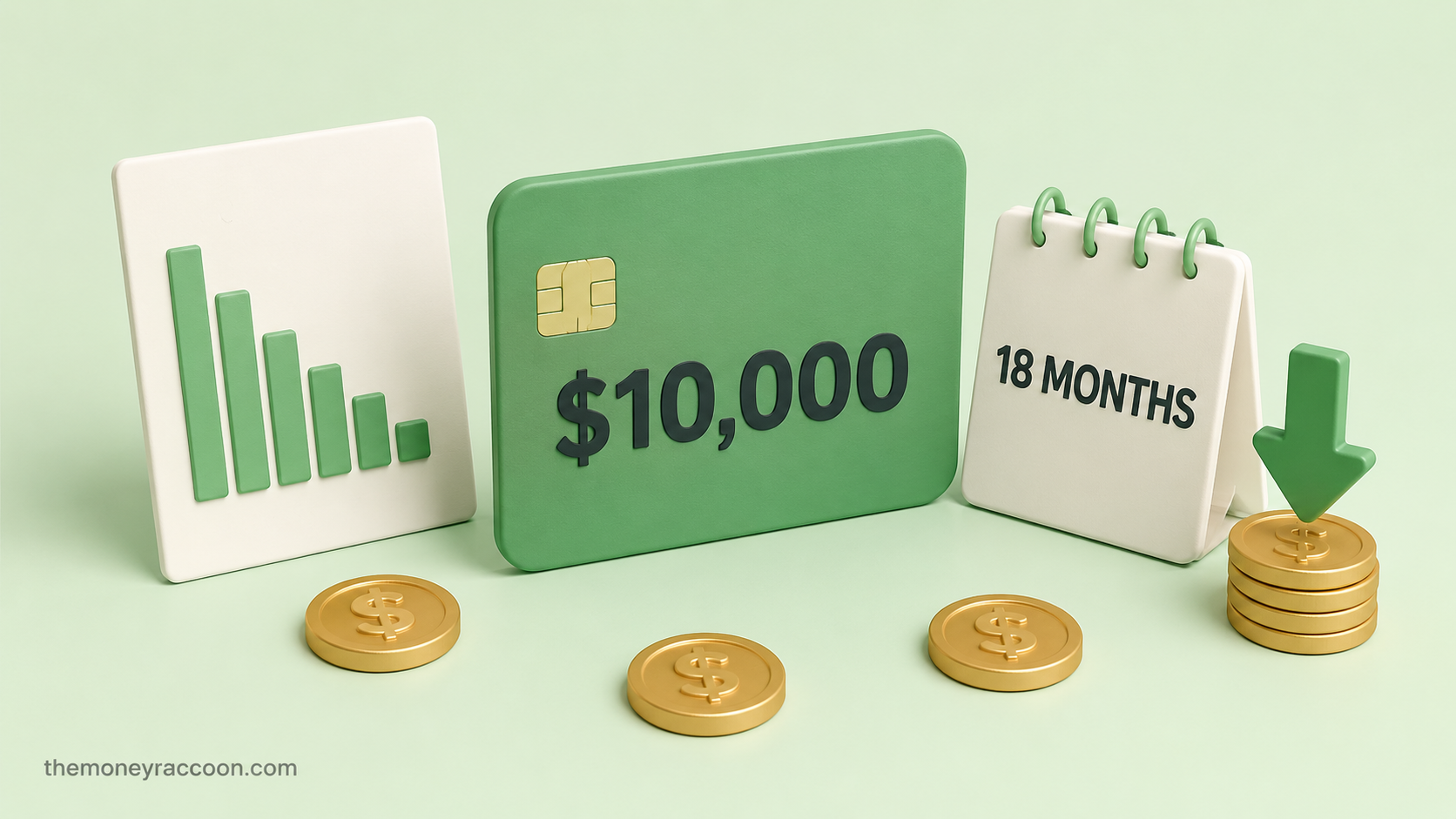
Figuring out how to pay off 10000 in credit card debt starts with a number nobody at the bank will ever tell you: at 24% APR, making only the minimum payment, that $10,000 takes 22 years to clear and costs you over $18,000 in interest along the way. You’d pay for the debt nearly three times over.
That’s not a plan. That’s a subscription to your own past.
Here’s the plan instead: an 18-month payoff that’s demanding but real, the exact monthly number to hit, the calculated math so you can see every dollar, and four levers that cut the interest dramatically — including one that can drop it to zero. If you’ve got $10k staring back at you, this is the way out.
In one paragraph: To pay off $10,000 in credit card debt in 18 months at a typical 24% APR, you need to pay about $668 per month — total interest around $2,020. Cut the rate first (a 0% balance transfer drops the monthly to ~$556 with near-zero interest), then attack it with a fixed monthly payment. Paying only the minimum instead would take roughly 22 years and $18,000+ in interest.
The Real Math on $10,000
No sugarcoating, no vague “pay more than the minimum.” Here’s what the numbers actually do at today’s average interest-accruing card rate of about 24% APR:
| Approach | Monthly Payment | Time to Payoff | Total Interest |
|---|---|---|---|
| Minimum only (interest + 1%) | starts ~$235, shrinks | ~22 years | $18,562 |
| Fixed $400/month | $400 | ~33 months | $3,140 |
| 18-month plan (24% APR) | ~$668 | 18 months | ~$2,020 |
| 18-month plan + 0% balance transfer | ~$556 | 18 months | ~$300–500 (just the fee) |
| 12-month sprint (24% APR) | ~$946 | 12 months | ~$1,340 |
Read the first row twice, because it’s the trap millions live in: minimum payments are designed to keep you paying. Every other row is you taking the wheel. The difference between “minimum only” and “18-month plan” is roughly $16,500 in interest and two decades of your life.
How to Pay Off 10000 in Credit Card Debt: The Step-by-Step Plan
Step 1: Freeze the balance. You cannot bail out a boat with a hole in it. Stop new charges on the card today — move daily spending to cash or debit while you attack the debt. This one decision does half the work.
Step 2: Cut the interest rate before you cut the balance. This is the highest-leverage move and most people skip it. Three ways, in order of impact:
- 0% balance-transfer card: if your credit qualifies, move the $10k to a card offering 0% for 15–21 months. You’ll pay a 3–5% fee ($300–500), but you save ~$1,500+ in interest and every dollar you pay hits principal. This alone drops the required monthly payment from ~$668 to ~$556.
- Call and ask for a lower APR: 83% of people who ask get a reduction — free, five minutes, no downside.
- Negotiate directly if you’re already struggling — the hardship-plan scripts are here.
Step 3: Set the fixed monthly payment. At 24% APR, ~$668/month clears it in 18 months. With a 0% transfer, ~$556. Pick your timeline, get the number, and treat it like rent — non-negotiable, automated on payday.
Step 4: Find the money (it’s usually there). $668/month feels impossible until you hunt for it: one round of bill negotiations frees $50–150/month permanently; pausing subscriptions and eating out adds more; a temporary side gig closes the gap. You don’t need to find $668 of new money — you need to redirect money that’s already leaking.
Step 5: Aim every windfall at it. Tax refund, bonus, birthday cash — straight to the balance. A single $1,500 tax refund knocks two-plus months off the plan and hundreds off the interest.
One Card or Several? (If Your $10k Is Split Up)
If the $10,000 is spread across multiple cards, the plan gets one extra decision: attack order. Two proven methods — pay the smallest balance first for psychological momentum (snowball), or the highest APR first for maximum savings (avalanche). We ran the real month-by-month math on both, and the honest verdict is that the best method is the one you’ll actually finish. Either way, the fixed-payment engine above is what powers it: same total monthly amount, rolled from dead cards onto the next.
The Traps That Blow Up the Plan
Charging while you pay. The single most common reason 18-month plans become 5-year plans. The card goes in a drawer (or the freezer) until the balance is $0.
Chasing the balance transfer, then paying the minimum. A 0% card is a gift only if you clear it before the promo ends — otherwise the rate snaps back to 25%+ on whatever’s left. Divide the balance by the promo months and pay that, automatically.
Draining your emergency fund to zero. Keep a small $500–1,000 cushion even while attacking debt — without it, the first car repair goes right back on the card and undoes months of work.
Paying a debt settlement company. They charge thousands and wreck your credit on purpose. Everything on this page you can do yourself for free.
Eighteen months. That’s the real answer to how to pay off 10000 in credit card debt without gimmicks — cut the rate, set a fixed ~$668 (or ~$556 at 0%), automate it, and defend it from new charges. It’s not painless, but it’s finite, and finite is everything. The alternative — minimums, 22 years, $18,000 in interest — is the truly expensive path, even though it feels easier month to month. Pick the hard 18 months. Future you signs the thank-you card.
FAQ: How to Pay Off 10000 in Credit Card Debt
How long will it take to pay off $10,000 in credit card debt? It depends entirely on the monthly payment. Minimums only: ~22 years and $18,000+ interest. $400/month: ~33 months. About $668/month clears it in 18 months at 24% APR; ~$946/month does it in 12. Cutting the rate with a 0% transfer shrinks every one of those.
What’s the monthly payment to pay off $10,000 in 18 months? Roughly $668/month at a typical 24% APR (total interest ~$2,020). With a 0% balance-transfer card, about $556/month — because nearly all of it goes to principal instead of interest.
Is a balance transfer worth it for $10,000? Usually yes, if you qualify: a 3–5% fee ($300–500) buys you 15–21 months of 0% interest, saving ~$1,500+ versus 24% APR — as long as you clear the balance before the promo ends. Divide the balance by the promo length and automate that payment.
Should I use my savings to pay off credit card debt? Partly. Keep a $500–1,000 emergency cushion, then aim surplus savings at the card — a 24% card is a guaranteed 24% “return,” which no savings account matches. Don’t go to zero savings, or the next surprise expense recreates the debt.
Will paying off $10,000 improve my credit score? Significantly, usually — because it slashes your credit utilization, one of the biggest scoring factors. Many people see their score climb within a couple of months of knocking down a large balance. Here’s the full recovery playbook.
Data sources: LendingTree — Average credit card interest rates, CFPB — Paying down credit card debt. Payoff figures are our own amortization calculations at 24% APR.

Personal finance writer, founder and editor of The Money Raccoon — 5 years in the industry and 1,000+ articles published in the finance niche. I turn complex money rules — credit scores, debt, banking and investing — into plain-English guides backed by primary sources and real numbers. Every guide here is fact-checked against the institutions that publish the data and updated when the numbers change.