
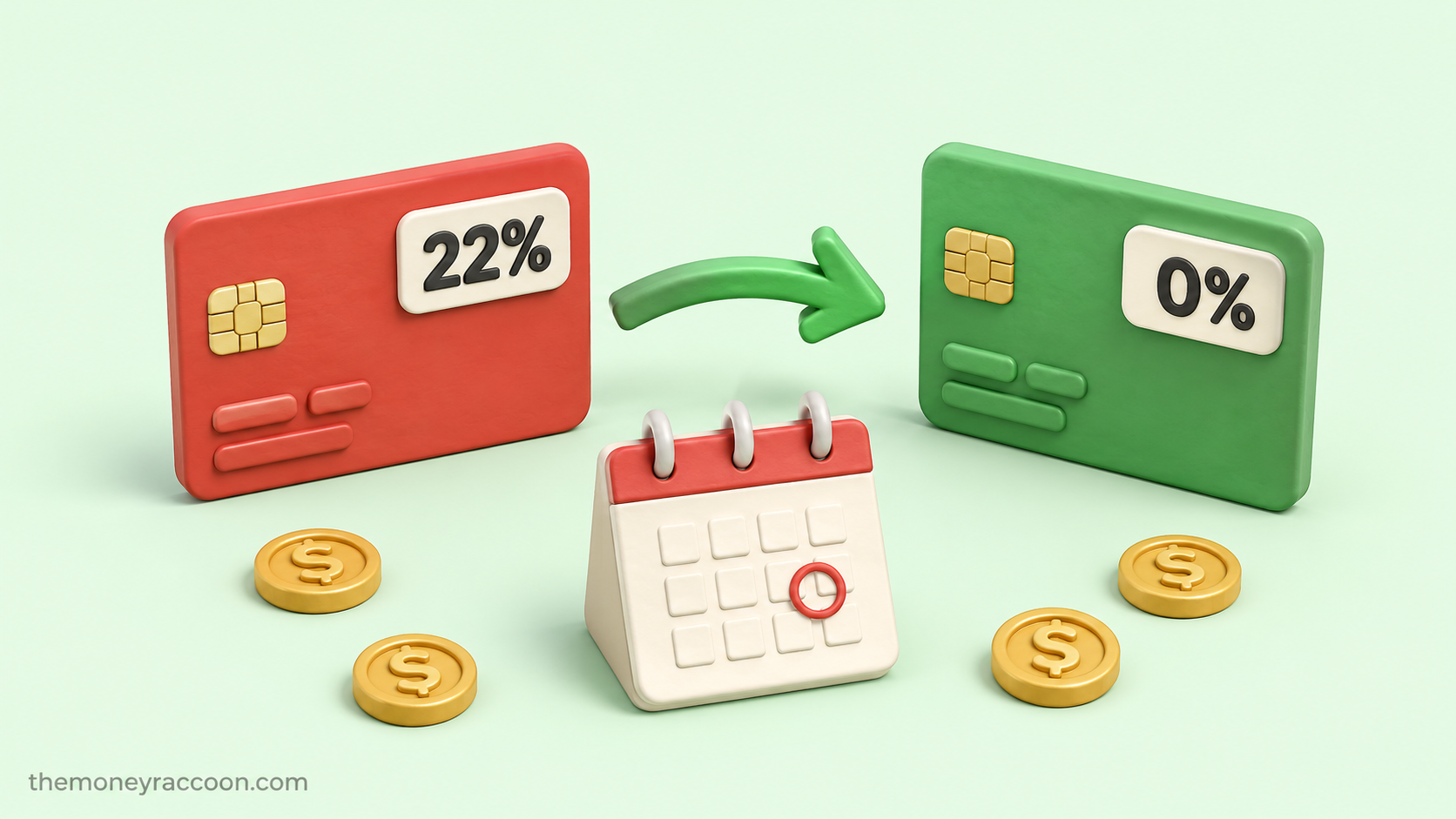
With average credit card APRs sitting around 22%, 0 APR balance transfer cards are the single most powerful legal tool for anyone carrying a balance — and one of the easiest to get wrong.
Done right on an average balance of $7,886, a transfer saves roughly $1,700 in interest and cuts years off the payoff. Done wrong, it costs a fee, resets nothing, and lands you back where you started with an extra card open.
The difference between those two outcomes isn’t luck or credit score. It’s understanding five specific traps built into how these offers work — traps that card issuers count on, because the business model assumes a meaningful share of people won’t clear the balance before the promo ends.
Current offers run as long as 21 months at 0%, which is genuinely a lot of runway. This guide covers the real math on your balance, the five traps in order of how much they cost, and the checklist that turns a transfer into an actual payoff instead of a delay.
The quick version: A 0 APR balance transfer card moves existing debt to a new card that charges no interest for an intro period — currently up to 21 months on the longest offers — in exchange for a transfer fee of 3–5%. It’s worth it when you can clear the full balance before the promo ends: on $7,886 at 22% APR, transferring saves roughly $1,700 net of a 3% fee. It backfires if you only make minimums, add new purchases, transfer late (most cards require the transfer within 60–120 days), or miss a payment.
The Real Math on a $7,886 Balance
Using the average balance carried by American cardholders, at a typical 22% APR:
| Scenario | Monthly Payment | Time to Zero | Total Interest + Fees |
|---|---|---|---|
| Stay put, minimum payments | ~$158 falling | 20+ years | $12,000+ |
| Stay put, fixed $438/month | $438 | ~23 months | ~$1,900 |
| Transfer to 0% for 21 months (3% fee) | $387 | 21 months | ~$237 (fee only) |
| Transfer to 0% but pay minimums | ~$158 | Promo expires w/ balance | Fee + 22%+ on the remainder |
Estimates; your card’s terms govern.
Rows three and four are the entire article. Same card, same offer, opposite outcomes — the only variable is whether you divide the balance by the promo months and pay that number. Row three saves about $1,700 versus staying put. Row four pays a fee for a delay and then meets the same interest rate it fled, often on a card with a higher go-to APR.
The formula that decides your fate is one line:
Balance ÷ promo months = your non-negotiable monthly payment. On $7,886 over 21 months, that’s $376 plus the fee — call it $387/month. If that number doesn’t fit your budget, the transfer alone won’t save you; a payoff plan has to come first.
0 APR Balance Transfer Cards: The 5 Traps
Trap 1 — The transfer fee nobody budgets for. Nearly every offer charges 3–5% of the transferred amount, added to your balance immediately. On $7,886 that’s $237 to $394. It’s usually still worth paying, but run the comparison: fee versus interest you’d otherwise pay. And note the spread — some cards charge 3% while many charge 5%, which is a $157 difference on the same balance.
Trap 2 — The transfer window. This one silently voids the whole plan. Most cards require the transfer within 60 to 120 days of account opening to get the promo rate. Open the card, get busy, transfer in month five, and the balance lands at the regular APR. Do the transfer the same week the card arrives.
Trap 3 — New purchases on the new card. Some cards apply 0% only to transfers, not purchases — so new spending accrues interest immediately, and payment-allocation rules generally send your payment to the lowest-rate balance first, meaning your purchases can sit accruing while you pay down the transfer. Rule: the transfer card is a payoff vehicle, not a wallet card.
Trap 4 — Minimum payments and the promo cliff. Making minimums during a 0% window feels fine and ends badly: whatever remains when the promo expires starts accruing at the go-to APR, often 25%+. Set the fixed payment on autopay the day the transfer lands.
Trap 5 — Reusing the freed-up old card. The old card now shows a $0 balance and full available credit. Charging it back up leaves you with two balances instead of one — the most common way transfers make things worse. Keep it open (it helps your utilization and account age) but out of your wallet.
One late payment can end the promo. Most issuers can revoke the intro rate after a late payment. Autopay isn’t optional here — it’s the whole strategy’s safety mechanism.
When a Transfer Is the Right Move — and When It Isn’t
It’s right when: you have a clear balance you can realistically clear within the promo window, your credit is good enough to qualify (these are prime-credit products, generally 670+), the fee is smaller than the interest you’d otherwise pay, and — most important — the spending that created the balance has stopped.
It’s wrong when: you’re still adding to the balance monthly (a transfer just gives a fresh runway to fill), the balance is so large that the required monthly payment is impossible, you’re already behind on payments (approval is unlikely, and negotiating directly with your issuer is the better path), or you’d be tempted to run the old card back up.
If you don’t qualify: don’t stop at the rejection. Ask your current issuer for a lower APR (a five-minute call works more often than people expect), consider whether a debt consolidation loan fits better, and raise your score first — approval odds for the longest 0% offers rise sharply above 700. Meanwhile, the payoff method you choose still moves the balance without any new card.
(Educational content, not financial advice — verify all card terms before applying.)
How to Choose and Execute (Checklist)
What to compare, in priority order:
- Promo length on transfers — the longest current offers run about 21 months. Longer window = smaller required payment.
- Transfer fee — 3% versus 5% is real money; on $7,886 the gap is $157.
- Transfer deadline — 60 days versus 120 days changes how much slack you have.
- Whether purchases are also 0% — irrelevant if you follow the “payoff vehicle only” rule, but worth knowing.
- Go-to APR after the promo — your safety net if life interrupts the plan.
- Annual fee — the best balance transfer cards charge $0.
The execution checklist:
- Apply while the balance is stable and your utilization is as low as you can get it
- Initiate the transfer within days of approval — never near the deadline
- Keep paying the old card until the transfer posts (transfers take 5–14 days; a missed payment in the gap is a real risk)
- Calculate balance ÷ promo months, add a small buffer, set autopay for that amount
- Put the new card in a drawer, and the old card next to it
- Mark the promo end date on your calendar with a reminder 60 days ahead
Terms change constantly and vary by applicant — current offers are tracked by outlets like NerdWallet and CNBC Select, and the issuer’s own page is the only authority on what you’ll actually receive.
FAQ: 0 APR Balance Transfer Cards
How does a 0 APR balance transfer card work?
You open a new card with a 0% introductory rate on transfers, request that your existing balance move to it, and pay a fee of 3–5% of the amount transferred. For the promo period — currently up to about 21 months on the longest offers — every dollar you pay reduces principal instead of interest. When the promo ends, any remaining balance starts accruing at the card’s regular APR.
Is a balance transfer worth the fee?
Usually yes, if you clear the balance during the promo. On $7,886 at 22% APR, a 3% fee costs about $237 while the interest avoided over 21 months is roughly $1,900 — a net saving near $1,700. It’s not worth it if you’ll only make minimum payments, since you’d pay the fee and still face interest on the remainder.
What credit score do you need for a balance transfer card?
The best 0% offers are prime-credit products, generally requiring good to excellent credit (roughly 670+, with the longest promos favoring 700+). Below that, options narrow: ask your current issuer for a rate reduction, look at consolidation loans, or focus on raising your score before applying.
Does a balance transfer hurt your credit score?
Short term, slightly: the application creates a hard inquiry and a new account lowers your average account age. Medium term it often helps, because moving a balance to a new card raises your total available credit and lowers overall utilization — as long as you keep the old card open and don’t run it back up.
Can you transfer a balance between cards from the same bank?
Generally no. Issuers almost never allow transfers between their own cards — a Chase balance can’t move to another Chase card. Your transfer target has to be a card from a different issuer, which is worth checking before you apply.
Research and references: CNBC Select — Best 0% APR credit cards, August 2026, NerdWallet — Best balance transfer credit cards, Forbes Advisor — Longest 0% APR balance transfer offers, Credit Karma — Best balance transfer cards. Payoff figures are our own calculations at 22% APR. Card terms change frequently — verify with the issuer. Educational content, not financial advice.

Personal finance writer, founder and editor of The Money Raccoon — 5 years in the industry and 1,000+ articles published in the finance niche. I turn complex money rules — credit scores, debt, banking and investing — into plain-English guides backed by primary sources and real numbers. Every guide here is fact-checked against the institutions that publish the data and updated when the numbers change.